Financial Management: Applied Business Management

Welcome! My name is Dmytro. I am a Chief Financial Officer (CFO) with over 20 years of experience. Backed by professional qualifications including CAP (IFRS) and ACCA (Financial Management), I created this resource as a fundamental knowledge base for financial management. It systematizes my practical expertise gained in manufacturing, real estate development, and other sectors. On this site, you will not find fleeting news, but rather in-depth, evergreen materials – practical case studies, deep analysis of international standards, and business optimization strategies.

FINANCIAL MANAGEMENT→

FINANCIAL REPORTING

Recommended Reading

Cinematic 3D illustration of business transformation: rusty gears of chaos passing through an optimization prism and turning into a stream of golden coins, symbolizing profit and systemic efficiency.

Turn Operational Chaos into Cash: How TOC, Lean, and Six Sigma Work Together
Stop localized cost-cutting. Learn how to combine TOC, Lean, and Six Sigma (the TLS Model) to turn operational chaos into real profit and maximize Throughput.
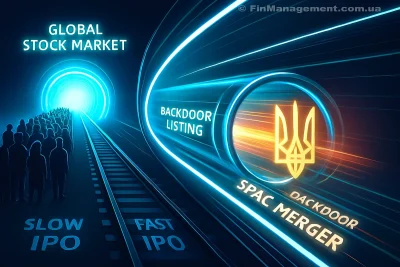
A visual metaphor showing a fast hyperloop tunnel representing a SPAC merger bypassing a slow traditional IPO track on the way to the NASDAQ global market.

The “Reverse” Route to Nasdaq: An Accounting Paradox Opening Doors for Ukrainian Business
Discover the "Backdoor Listing" strategy to Nasdaq via SPAC. A CFO explains the accounting of Reverse Mergers, IFRS 3 implications, and navigating NBU restrictions.
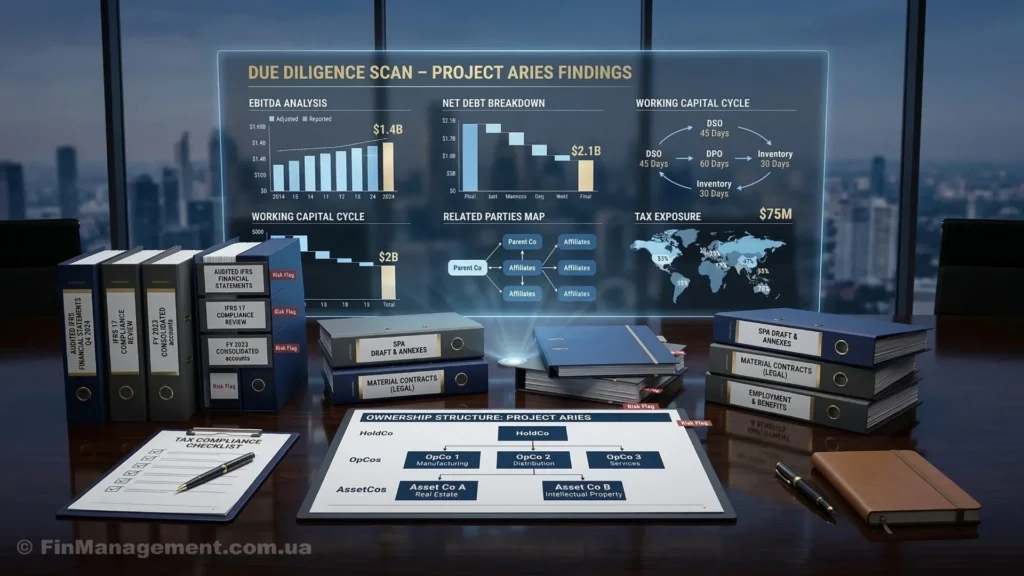
CFO desk with audit report binders and a holographic dashboard displaying financial due diligence findings, EBITDA metrics, and company ownership structure.

Financial Due Diligence: Preparing Emerging Market Businesses for Institutional Investors
Billions in investment capital are available on the market, but why is your business facing rejections? A successful deal starts not with a flashy pitch deck, but with asset structuring and balance sheet clean-up. Learn how to prepare your company for an institutional investor.
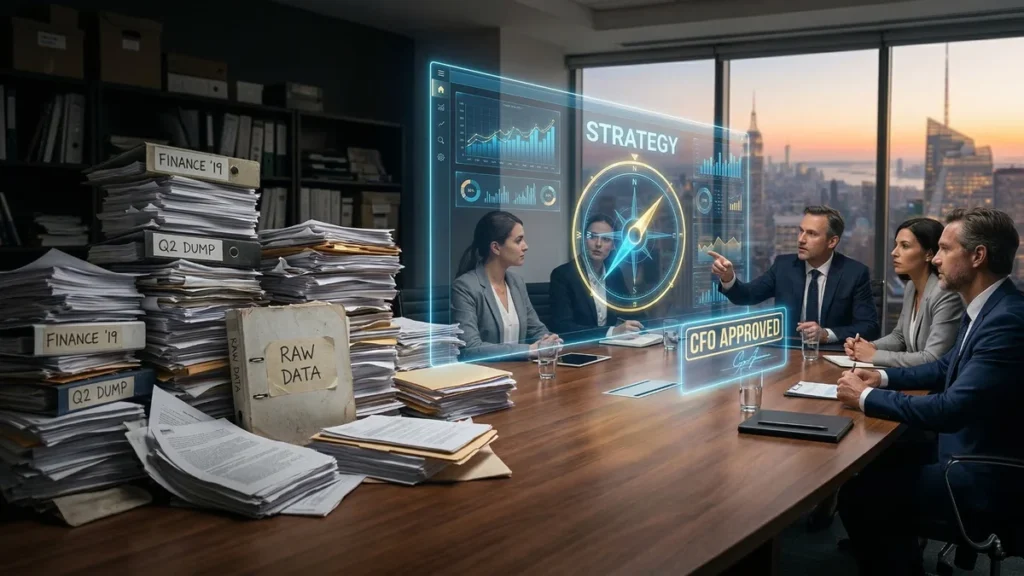
CFO presenting a strategic navigator on a holographic dashboard to the board of directors, replacing chaotic piles of paper financial reports.

Transforming Board Reporting: From a Data Graveyard to a Strategic Navigator

The Board of Directors shouldn't search for answers in a "data graveyard." A successful strategy begins with transparent management reporting and a Single Source of Truth (SSOT). Learn how a CFO can transform this process.
A confident CFO standing in a high-tech command center, analyzing global risk maps and stock market data on curved screens while a storm rages outside, representing strategic risk control.

Strategic Resilience Architecture: How to Build a Risk Management System for Small and Medium-sized Enterprises (SMEs)
Risk management is not about expensive software; it's about culture and discipline. In this guide, we deconstruct how Ukrainian SMEs can build a "Strategic Resilience Architecture" using simple tools like Risk Matrices, KRIs, and Nassim Taleb’s philosophy of Antifragility. Transform your business from fragile to robust.
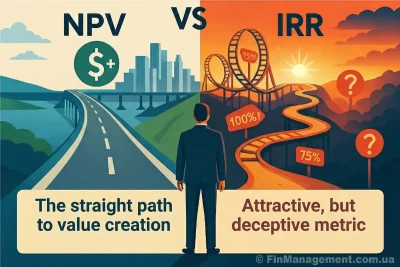
A business concept illustration showing a manager at a fork in the road. The "IRR Route" looks easy but hides traps labeled "Multiple Rates," "Reinvestment Trap," and "Scale Problem." The manager chooses the steeper but solid "NPV Route" labeled "Reliable Value."

IRR vs. NPV: Why a Popular Investment Evaluation Method Can Mislead You

NPV vs. IRR: Is your favorite investment metric lying to you? A CFO explains why Internal Rate of Return (IRR) is flawed and why Net Present Value (NPV) remains the only reliable criterion.
A seasoned CFO at a drafting table reviewing financial models designed as architectural blueprints, symbolizing the strategic role of budgeting in business stability.

Budgeting as a Business Navigation System: From “Shackles” to Modeling

Transform your business budgeting system from a "bureaucratic nightmare" into a strategic tool. Learn how to build a Master Budget to model future success.
Illustration of a businessman wearing a VR headset displaying upward charts, unknowingly walking off a digital cliff into an abyss, symbolizing the risk of ignoring real data.

Toxic KPIs: How Misguided Motivation Kills Business

Green dashboards don't mean a healthy business. Learn why focusing on EBITDA, purchase price, or machine utilization might be driving your company off a cliff, and discover the 3 golden rules of healthy incentives.
A split-screen comparison image. The left side shows a crumpled piece of paper with handwritten notes, representing a basic static plan. The right side displays a laptop screen with sophisticated financial analytics and charts, representing a dynamic financial model. Text overlay reads: "The same 'plan – only with a brain."

Plan = Model. If Not, It’s Just a Wish List
"Napkin planning" is dead. Discover why a financial model is the "digital twin" of your business that turns a wish list into a navigable map for growth.
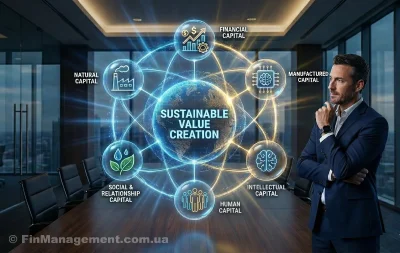
A futuristic concept photograph of a CFO in a modern boardroom analyzing a sophisticated holographic data display. The hologram features a central glowing core labeled "SUSTAINABLE VALUE CREATION" surrounded by six interconnected data nodes representing the six capitals: financial graphs, factory gear (manufactured), intellectual brain, diverse people (human), social network, and a green leaf (natural) icon.

Integrated Reporting: From Voluntary Initiative to the New Standard of Corporate Transparency
Why CFOs and Supervisory Board Members Must Prepare for the New Era of Corporate Reporting Today Introduction: The Evolution of Corporate Reporting: From Figures to a Holistic Vision As a…
IFRS for SMEs Overview Cover: Part 1. Standard Concept and First-time Adoption.

IFRS for SMEs Standard – An Overview

Who is eligible for IFRS for SMEs? How does it differ from full IFRS? This guide covers the fundamentals (Sections 1-2), the “Undue Cost” concept, and a step-by-step transition plan (Section 35) for CFOs.
Cover image for IFRS 1 guide: First-time Adoption and financial reporting transformation.

IFRS 1: First-time Adoption and Transformation

The transition to IFRS is not merely a change in accounting policy but a strategic transformation that grants business access to international capital markets. IFRS 1 serves as the fundamental…

Scroll to Top