Financial Management: Architecture of Business Growth

A Chief Financial Officer creates value at the intersection of two worlds: flawless internal operational efficiency and aggressive external growth. This hub unites the two fundamental pillars of financial management. On one side, the architecture of management accounting provides precise figures for daily decisions and protects the business against local losses. On the other, corporate finance tools allow you to manage capital, evaluate investment projects, and relentlessly scale the company’s market value. Choose the relevant section below to access proven CFO tools and practical insights.

Explore by Category

Recommended Reading

A visual metaphor showing a fast hyperloop tunnel representing a SPAC merger bypassing a slow traditional IPO track on the way to the NASDAQ global market.

The “Reverse” Route to Nasdaq: An Accounting Paradox Opening Doors for Ukrainian Business

Discover the "Backdoor Listing" strategy to Nasdaq via SPAC. A CFO explains the accounting of Reverse Mergers, IFRS 3 implications, and navigating NBU restrictions.
A split-screen business concept illustrating the "Make or Buy" decision. The left side depicts a modern manufacturing facility with automated machinery (Make). The right side shows a warehouse dock with goods arriving from a supplier (Buy). In the center, a CFO analyzes financial data on a tablet to choose the best strategy.

Make or Buy? How to Avoid Fatal Decisions
Should you manufacture or outsource? Don't rely on full production costs. Learn how to analyze relevant costs, opportunity costs, and strategic risks correctly.
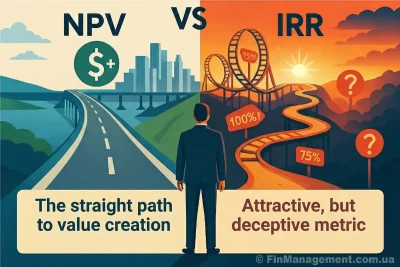
A business concept illustration showing a manager at a fork in the road. The "IRR Route" looks easy but hides traps labeled "Multiple Rates," "Reinvestment Trap," and "Scale Problem." The manager chooses the steeper but solid "NPV Route" labeled "Reliable Value."

IRR vs. NPV: Why a Popular Investment Evaluation Method Can Mislead You

NPV vs. IRR: Is your favorite investment metric lying to you? A CFO explains why Internal Rate of Return (IRR) is flawed and why Net Present Value (NPV) remains the only reliable criterion.
A seasoned CFO at a drafting table reviewing financial models designed as architectural blueprints, symbolizing the strategic role of budgeting in business stability.

Budgeting as a Business Navigation System: From “Shackles” to Modeling

Transform your business budgeting system from a "bureaucratic nightmare" into a strategic tool. Learn how to build a Master Budget to model future success.
Realistic close-up of a hand drawing a thick upward red trend line across a 3D blue bar chart. The visualization represents significant exponential growth in revenue and business efficiency against a professional grid background.

EBITDA: What Is It and Should You Trust This Metric?

What is EBITDA? Discover why this non-GAAP metric can differ from Net Profit, why Warren Buffett criticizes it, and how to analyse it alongside Capex. A CFO's perspective.
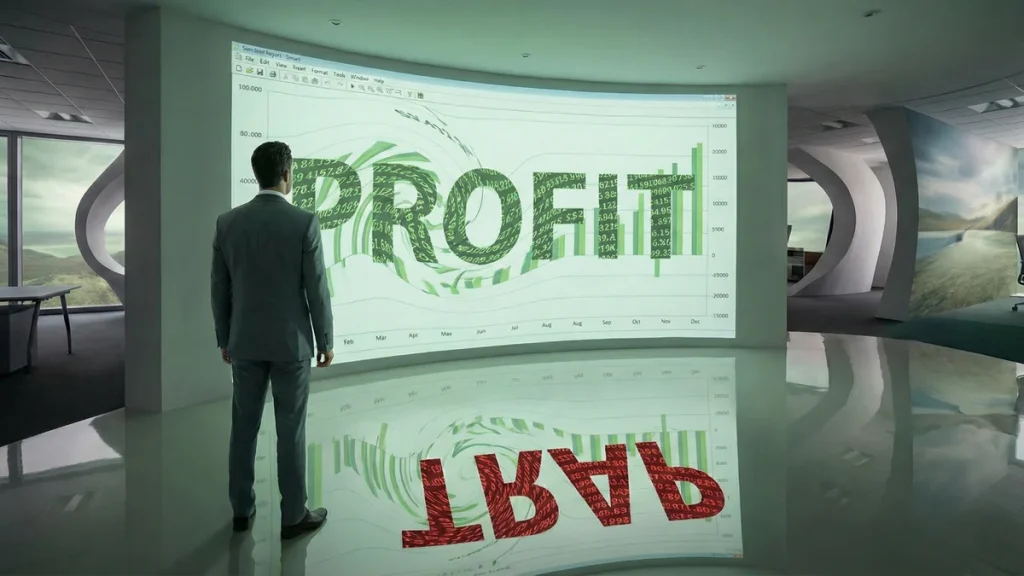
Бізнесмен дивиться на великий екран із зеленим графіком у вигляді слова PROFIT (Прибуток), яке відбивається на глянцевій підлозі як червоне слово TRAP (Пастка).

Пастки собівартості (частина 1)

Продаж продукції за ціною, нижчою від бухгалтерської собівартості, може збільшити прибуток підприємства. І, навпаки, продаж продукції/товару за ціною вище за собівартість може зменшувати прибуток. А в деяких випадках, випускаючи продукцію з меншим маржинальним прибутком на одиницю продукту, можна заробити більше грошей, ніж випускаючи більш прибутковий продукт.

Explore Related Topics

Scroll to Top