
CFO’s Foreword:
Inventory management traditionally remains a battlefield between the commercial department, which demands “having absolutely everything in stock,” and the finance team, which fights against frozen working capital. Most companies try to solve this dilemma using complex demand forecasting algorithms, but in reality, they still suffer a double blow: lost sales due to local stockouts and warehouses overflowing with illiquid inventory.
In my practice of building business management systems, I have repeatedly been convinced: the most reliable solutions always lie in systemic simplification. Henry F. Camp’s material on applying the Theory of Constraints (TOC) to supply chains is not a theoretical abstraction. It is a rigorous, mathematically justified guide to freeing up your cash flow. It shatters the classic stereotype that uninterrupted product availability inevitably requires inflating safety stocks.
I prepared this analytical summary of Henry F. Camp’s article because it offers a strict framework for unlocking cash flow. This is a guide on how transitioning from the traditional “pushing” of goods according to a plan to dynamic buffer management can exponentially increase ROI and net profit without the need for external financing.
— Dmytro Dodenko
1. The Complexity Trap: Why the Traditional Paradigm is a Systemic Failure
Modern distribution and retail businesses have turned into testing grounds for battling artificially created complexity. Executives consider sprawling supply chains spanning dozens of time zones, stockouts of fast-moving items against the backdrop of overstocked warehouses, and constant “firefighting” to be the norm. However, it must be acknowledged: the traditional forecasting-based management paradigm is a systemic failure that mathematically guarantees capital degradation.
Attempts to “guess” future demand only deepen the crisis. When we try to overcome complexity through even more complex forecasting algorithms, we only increase the volume of errors. The real symptoms of this inefficient reality are devastating:
- Chronic stockouts: Losing at least 10% of revenue due to product unavailability at the moment of request.
- Surpluses and illiquid inventory: Freezing working capital in goods that have to be “dumped” for next to nothing.
- Low inventory turnover: Capital gets “stuck” in inventory, forcing the business to rely on heavy credit loads.
- Profit erosion: The cumulative effect of write-offs and lost sales negates any marketing successes.
Further refinement of forecasts will not yield results. We do not need a “better crystal ball,” but a radical change in the management model — a shift from pushing (Push) to pulling (Pull).
2. The “Utopian Warehouse” Concept: Materializing Operational Excellence
To deconstruct outdated management habits, we must look to the model of an ideal system. Imagine a warehouse where every sold item is instantly replaced by an identical unit. This is the mechanism of the “invisible thread”: as soon as a customer takes an SKU off the shelf, they pull the next instance directly from the supplier through this thread.
This model fundamentally changes the physics of warehouse space. Where traditional methods previously required ten racks to store a 60-day “just-in-case” inventory, two racks become more than enough under the TOC system. Freeing up 80% of the space is not magic, but the result of refusing to store forecasting errors.
Comparing Management Paradigms
- Forecasting (Push): An attempt to predict the future, which inevitably leads to the accumulation of inventory the market does not need, or shortages of what it demands.
- TOC Replenishment (Pull): Reacting to actual consumption. The system replaces only what has already generated cash, maintaining a perfect balance of availability.
This utopia is the foundation of our transformation. We are not just dreaming about it — we are implementing it through the elimination of stockouts as the first step toward exponential growth..
3. Eliminating Stockouts and Assortment Expansion: Escaping the Illiquid Inventory Trap
Product availability is not a “desired metric,” but the foundation of market share. Stockouts steal between 10% and 20% of sales from a typical player. Eliminating this factor automatically translates into a 5% increase in net profit without any additional operating expenses.
Consider the example of a wholesale fashion apparel distributor. In the traditional model, the fear of illiquid inventory (the risk of rapid inventory obsolescence at the end of the season) forces them to limit the assortment. Turnover drops, and cash is drained. The TOC replenishment system removes this risk. When we transition to the Pull model, we achieve:
- Radical assortment expansion: Thanks to freed-up capital and space, the company can test a much wider matrix of products.
- Risk minimization: If a product does not sell, we do not order new batches, and the existing volume is minimal.
- Alignment of interests: Suppliers become partners, as they are just as interested in the availability of bestsellers as you are.
Achieving this reality requires abandoning subjective planning in favor of a mathematical engine — managing replenishment time.
4. The Technology of Changing Reality: Inventory Aggregation and Dynamic Buffer Management
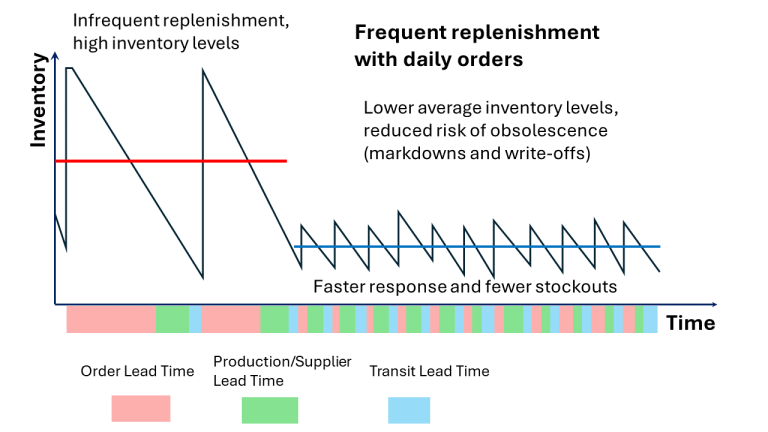
A key management mistake is equating the supplier’s lead time (Supply Lead Time) with the total replenishment time (Replenishment Time). The former is an external constraint; the latter is a consequence of internal processes.
TOC replenishment time consists of three critical elements:
- Order Lead Time: The period from a sale to order placement. TOC completely eliminates this stage through the daily, automatic transmission of consumption data.
- Production/Supplier Lead Time: The manufacturing or production cycle.
- Transit Lead Time: Physical delivery.
Strategic Inventory Aggregation: Counterintuitively, we should not hold the main stock close to the consumer. By keeping the bulk of the goods at a central warehouse, we aggregate demand. Sales variability at individual locations cancels each other out, allowing for a radical reduction in the total volume of inventory in the system while maintaining 100% availability.
Dynamic Buffer Management (DBM): This is the system’s self-regulating shock absorber. Each SKU has its own buffer, which the system checks daily:
- If inventory is too low for too long, the buffer automatically increases.
- If inventory is too high, the buffer decreases, freeing up cash.
Transitioning to buffer management instead of forecasting is a shift from guessing to mathematical certainty, exponentially simplifying operational activities.
5. The Financial Architecture of Success: Turning Logistics into Profit
The operational transformation under TOC has a clear financial dimension. This is not mere “process improvement,” but a fundamental restructuring of the company’s P&L and balance sheet.
| Metric | Current Performance | TOC Methodology |
|---|---|---|
| Sales | 100 | 150 |
| Gross Profit | 30 | 53 |
| Net Profit | 2 | 25 |
| Inventory Turnover (times/year) | 4 | 8 |
| Inventory on Balance Sheet | 18 | 12 |
| Return on Investment (ROI) in Inventory | 11% | 208% |
Financial Commentary: The most telling indicator of system health is the leap in inventory ROI from 11% to 208%. Note the mechanics of this jump: the company not only increased sales by 1.5 times but simultaneously reduced the absolute amount of frozen capital in inventory by a third (from 18 to 12 units).
The cash freed from illiquid assets (equivalent to 6% of the initial turnover) instantly converts into free cash flow. Top management faces a new strategic task of aggressively reinvesting this surplus:
- The Conservative Path: Debt repayment (interest savings).
- The Expansion Path (The Virtuous Cycle): Reinvesting in assortment expansion. Since the risk of illiquid inventory in a Pull system is minimized, every hryvnia of reinvested capital works with a 201% profitability, creating a growth cycle that competitors on a Push model are physically unable to catch up with.
6. Conclusion: The Strategic Choice Between Complexity and Profitability
Transitioning to the TOC replenishment model is not a technological upgrade, but an intellectual disinfection of the business model. The choice is simple: either you continue investing resources into fighting the chaos of forecasting, or you change the very reality of inventory management.
Implementing TOC makes the system transparent, scalable, and financially invulnerable. The main obstacle on this path lies not in logistics or software, but in the minds of management accustomed to “guessing.” The company that is first in the market to replace forecasts with mathematically justified replenishment will gain a decisive competitive advantage: flawless product availability with minimal inventory. This is the only path to a radical increase in ROI and operational excellence.
Source: The original article by Henry F. Camp, “Why Fight Reality with Complexity when you can Change Reality?”, published in the collection Echoes of Theory of Constraints (TOC) – Volume 1 (compiled by Rajeev Athavale). Publication page: Leanpub.
Analytical summary and adaptation prepared for FinManagement.com.ua.
Questions for Reflection:
- Forecasts vs. Speed: How much time and resources does your company spend on futile attempts to “perfect” demand forecasting algorithms, instead of physically reducing the replenishment cycle (Lead Time)?
- The Price of Frozen Capital: What is the exact amount of your working capital currently tied up in illiquid inventory (stock with no movement for over 60 days), while the commercial department loses margin due to stockouts of fast-moving items?
- The Math of Batching: Does your procurement department continue to order goods in large batches (e.g., full truckloads) for the sake of illusory “logistics savings,” ignoring the real inventory carrying costs and the risk of obsolescence?
- Reinvestment Vector: If, by transitioning to a Pull model, you free up even 5-10% of your working capital this quarter, where exactly will you direct it to generate maximum profit (Throughput)?