

CFO’s Foreword:
As a CFO, I constantly see how operational inefficiency directly erodes a company’s bottom line. We can build perfect budgets and investment models, but if teams miss deadlines due to multitasking and “Student Syndrome,” our financial goals remain nothing more than ink on paper. I prepared this analytical summary of Kedar Amdekar’s article because it offers a pragmatic framework for doubling output without increasing headcount. This is a guide on how to stop controlling people and start managing the velocity of the task flow.
— Dmytro Dodenko
1. The Deadline Paradox: Why Traditional Control Methods Fail
Most management tools try to “squeeze” productivity through pressure on the executor. However, these methods have built-in systemic flaws that make them ineffective in the long run.
| Conventional Method | Why It Fails (Systemic Flaw) |
|---|---|
| Date Commitments | In an environment of uncertainty, people are forced into a “defensive position,” stating maximally inflated (safe) dates. |
| Expert Time Standards | Work rarely fits into a rigid standard, as no expert can foresee all external variations and obstacles. |
| The “Carrot and Stick” System | Tying rewards to deadlines incentivizes people to hide real problems and manipulate timelines to avoid punishment. |
| Tracking Software | Software only records the “post-factum” status. Moreover, teams often “game” the software, reflecting the desired picture instead of the real one. |
We must acknowledge: traditional control does not accelerate work; it merely creates an illusion of manageability. The true solution to the problem begins with understanding the nature of uncertainty.
2. The Nature of Uncertainty: Why an Exact Forecast is an Illusion
Imagine your daily commute to the office. You know the route perfectly, your experience is constant, and the scope of the task (distance) is fixed. But can you guarantee your arrival down to the second? No. You will state a range: “between 25 and 35 minutes.”
This variability is not a consequence of your poor performance, but the result of the impact of the external environment: traffic lights, traffic jams, or pedestrians. The same applies to any business process. Even without changing the scope of work or lacking skills, external factors always create a time range.
Diagnosis: The attempt to ignore this range and demand an exact number forces executors to artificially inflate plans (add a “safety buffer”) to protect themselves from risks.
3. Psychological Planning Traps: Student Syndrome and Parkinson’s Law
The very “time reserve” we build in to protect against uncertainty becomes a trap. The psychology of time management teaches us that the presence of a buffer provokes an unproductive waste of resources:
- Student Syndrome: Work only begins under the pressure of an impending deadline, which negates the protective reserve right at the start.
- Parkinson’s Law: Work expands to fill the entire time allotted for its completion. Even if a task can be done in 3 days, but a week is allocated, it will take a week so that management doesn’t “cut” the estimate next time.
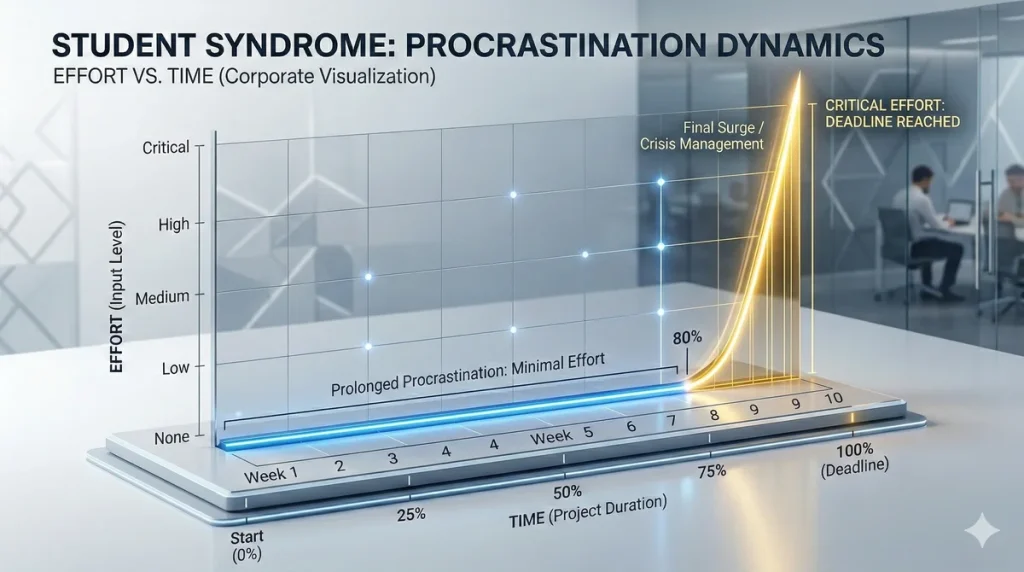
The logical connection is obvious: A safety buffer, created as protection against uncertainty, becomes the root cause of unjustified timeline extensions. To break out of this cycle, we need to stop focusing on the “working person” and look at the “moving task.”
4. The Fundamental Formula of Speed: Touch Time vs. Waiting Time
True productivity is determined not by the speed of hands, but by the absence of stops in the flow. The universal law of operational efficiency is as follows:
Task Time = Touch Time + Waiting Time
- Touch Time: The time of direct, active work on a task.
- Waiting Time: The time when a task lies motionless, waiting for a decision, information, or resource availability. This is the “black hole” of your process.
- Task Time: The sum of the first two. The full life cycle of a task at a specific stage. This is the total time a task has been “hanging” on the executor.
The fastest execution is execution without stops. We systematically ignore Waiting Time, considering it part of the workflow, even though it hides up to 80% of the total Lead Time losses. Reducing “touch time” yields marginal percentage savings, whereas eliminating “waiting time” delivers exponential profit growth.
5. The Three Horsemen of Delays: Where Are Your Losses Hiding?
Why does a task stop? We highlight three critical reasons:
- Multitasking: Switching attention stops the current flow. While you are doing “a little bit of everything,” each individual task is in a state of Waiting Time.
- Missing Inputs: Starting work without all the necessary data is a conscious choice that guarantees a stop in the future. “Half-done” work only clogs the flow.
- Unforeseen Obstacles: Any barriers that were not identified and eliminated immediately.
6. The Action Algorithm for Doubling Productivity
To achieve radical acceleration, we implement three flow management rules:
- Rule 1: Stop Multitasking (WIP Limit). Set a strict limit on the number of simultaneous tasks in progress (Work in Progress). Apply the “one out, one in” principle. No manager, including the CEO, has the right to interrupt an active task.
- Rule 2: Work with a Full Kit. A task has no right to become “active” until all necessary inputs have been gathered for it. Important: The Team Leader must prepare the Full Kit while the task is still on the waitlist. This is strategic preparation that eliminates stops after the start.
- Rule 3: Daily Flow Meetings. This is not a status report, but a flow diagnosis. A brief discussion: what was done in the last 24 hours and what is expected in the next 24 hours. The goal is to identify obstacles “here and now” to eliminate them within the current day.
7. Conclusion: A New Perspective on Efficiency
Efficiency is not the speed of executing operations, but the management of the gaps between them. True productivity lies in the “seams” of the process, not in the hands of the executors.
Implementing a flow management strategy allows you to reduce the overall Lead Time by 30% or more and effectively double the team’s output. Most importantly, this is achieved without involving additional resources or expanding the headcount.
Change the paradigm: stop “starting” new tasks — start finishing the ones already begun. True success is a task moving to the finish line without stops.
Original author of the core concepts: Kedar Amdekar. You can find the full version of the original article [Source].
Adaptation and executive summary by FinManagement.com.ua.
Questions for Reflection:
- The Time “Black Hole” Analysis: If we honestly analyze the lifecycle of a typical task in your company, what percentage of time is it actually being worked on (Touch Time), and how much is it simply waiting for a decision, inputs, or resource availability (Waiting Time)? Isn’t this waiting your largest hidden loss?
- The “Safe” Deadline Trap: Have you noticed that regardless of how much time you allocate to a project, the bulk of the activity unfolds in the final days before the deadline (Student Syndrome)? Isn’t it time to shift the focus from controlling dates to managing execution velocity?
- The Cost of Unfinished Work: How many tasks in your company are currently in the “work in progress” (WIP) status but are not moving toward the finish line? Are you, as a leader, ready to impose a strict limit on the number of open projects to radically accelerate the output of the final product?
- The “Full Kit” Audit: How often are your specialists forced to start work without having all the necessary data (Full Kit), just to “look busy”? How much time is subsequently wasted on rework and repeated approvals due to such a false start?
- Synchronization Efficiency: Are your meetings a retrospective search for the culprits of yesterday’s mistakes, or a diagnosis of the task flow for the next 24 hours? Do your managers leave meetings with a list of specific obstacles they must eliminate immediately?