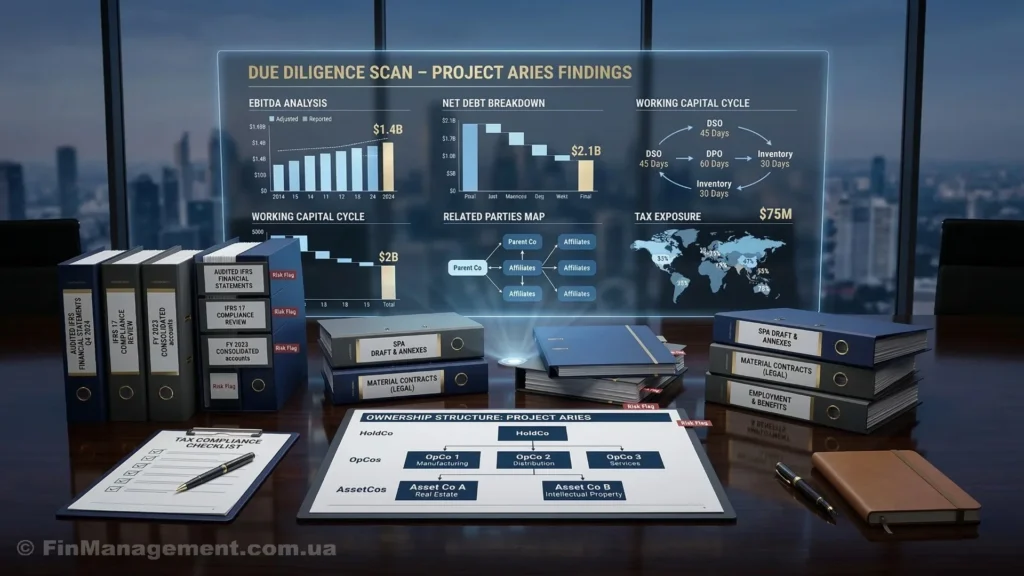
Financial Director analyzing toxic KPIs on a business dashboard that show profit but hide losses

Toxic KPIs: How Misguided Motivation Kills Business

Introduction

In business literature, the acronym KPI (Key Performance Indicators) is often presented as a “silver bullet.” The recipe for success seems simple: design a system of metrics, link salaries to them, and the team will start running like clockwork.

In my years in finance, I have seen countless reports where all the dashboards are green and bonuses are paid out, yet there is no cash in the company accounts. A paradox? No. This is the result of “toxic KPIs.”

Poorly selected performance criteria can lead to a decrease in profits rather than growth. Many business owners and top executives forget a primary axiom: a KPI is not just a ruler for measurement; it is a tool for behavioral programming.

If you tell people what you will pay them for, that is exactly what they will do. And believe me, they will find the shortest path to the payout, even if that path drives the company off a cliff.

Today, we will talk about “toxic KPIs”—metrics that look logical on paper but actually destroy your business in reality.

Trap #1. Procurement: Cheap Doesn’t Mean Cost-Effective

The Metric

A classic situation: the owner wants to cut costs. The Procurement Department is assigned a KPI: “Minimum Purchase Price” or “Purchase Price Variance (PPV) against Budget.”

The Scenario

What happens in practice? The procurement manager is a rational person. To secure their bonus, they:

  1. Squeeze existing suppliers. When the limit is reached, they switch to cheaper ones. This often means lower quality raw materials.
  2. Buy in bulk. To get a volume discount and lower the per-unit price, the manager orders enough stock for six months in advance.

The Result

  1. Drop in quality: Production suffers from defects, and customers are unhappy with the finished product.
  2. Tied-up capital: Mountains of “cheap” raw materials sit in the warehouse. Cash has transformed into illiquid inventory (stock) instead of working for the business.

The Solution

A buyer’s KPI should be based not on the price “in the moment,” but on Total Cost of Ownership (TCO) and Inventory (Stock) Turnover. Savings on price must not be outweighed by the cost of warehousing.

Trap #2. Sandbagging the Plan

The Metric

One of the most common mistakes is linking bonuses to “Percentage of Plan Attainment.”

The Scenario

What happens in practice? Tying premiums to “plan execution” incentivizes managers to lower targets. They “sandbag”—negotiating for a low plan so they can later heroically exceed it and secure their bonus.

I have a real-world example. The Sales Department, realizing their salaries depended on meeting the plan, began to sabotage the budgeting

process. For December, they fiercely argued that the market was dead and the maximum they could bring in was 60 million UAH. After tough negotiations, we approved 86 million UAH.

The Result

The actual result for December? 118 million UAH!

A victory, right? No. This means the planning system is broken. Salespeople intentionally lower the bar to guarantee a bonus for “overperformance.”

The same situation occurred in other departments.

The Solution

Compensation should depend not on how much you cleared a lowered bar, but on the actual value of the metric (a percentage of contribution margin, downtime of the production constraint, etc.).

Trap #3. Sales: Cash In vs. Real Profit

The Metric

Another popular but dangerous metric for the Sales Department is “Cash Receipts” (Cash In).

It would seem that cash in the bank is always good. We even excluded shipped but unpaid goods from the metric. However, if you view the Sales Department only as a Revenue Center and not as a Profit Center, you are taking a risk. The sales team is responsible not only for the volume of products sold but also for pricing. This means they directly impact profit.

The Disaster Scenario

Chasing cash collection targets, managers start actively taking prepayments for products that haven’t even been manufactured yet. They lock in the sales price today. But if we operate in an environment of rising raw material costs, we will be producing these goods a month later using more expensive inputs.

The Result

The cash has landed, the KPI is met, and bonuses are accrued. However, by the time production starts, the cost of goods sold (COGS) has risen, and we ship the product at a loss. The sales team are heroes; the company is in the red.

The Solution

  1. The key metric is Contribution Margin (Sales minus Variable Production Costs), not just “gross” cash flow.
  2. Bonuses are accrued and paid only for shipped and paid products. This aligns the manager’s interests with the company’s.

Trap #4. Production: Efficiency for Efficiency’s Sake

I often see this example in manufacturing enterprises (The “Tonnage” Trap).

The Metric

KPI: “Equipment Utilization” or “Production Volume in tons/units” aiming to reduce the unit cost.

The Scenario

What happens? The plant manager takes this literally: to lower unit costs, the machine must run 24/7. They run the line on the simplest, “heaviest” product that can be churned out without stopping for changeovers, or they launch huge batches of products that the market doesn’t need right now, simply to “spread” fixed costs over a larger number of units.

The Result

As a consequence, the warehouse is clogged with products that customers don’t currently need (dead stock). Complex, small, but high-margin orders are put on the “back burner” because they ruin the tonnage statistics.

Losses: We have frozen cash in unnecessary inventory and lost customers who were waiting for specific orders.

The Solution

We use the Theory of Constraints (TOC). Our goal is to maximize Throughput. If our constraint is in production, then the main metric is Throughput per Constraint Unit (Contribution per hour of the bottleneck’s operation).

I discussed the practical application of the Theory of Constraints (TOC) in my article, How Your “Most Profitable” Product Might Be Killing Your Business“.

Trap #5. Strategy: The EBITDA Illusion

The Metric

Toxic metrics occur even at the top management level. Owners often treat EBITDA (Earnings Before Interest, Taxes, Depreciation, and Amortization) as a holy grail—an indicator of the business’s ability to generate cash.

The Scenario

Let’s consider a manufacturing company where equipment contains expensive, high-wear components. In accounting, replacing these units might be classified as an investment (CAPEX) followed by depreciation. In reality, these are regular operating expenses required simply to keep the machines running. Furthermore, in any business, fixed assets (Non-current assets) eventually need replacement.

The Result

If we evaluate success based on EBITDA, we ignore depreciation. We see a beautiful profit figure, withdraw dividends, and a year later, discover there is no money for equipment repairs because the “depreciation fund” existed only on paper.

The Solution

In capital-intensive industries, it is more honest to look at EBIT (Operating Profit), which accounts for depreciation as an expense, or to use Operating Cash Flow less Maintenance Capex. The significance of EBIT lies in assessing a company’s operating efficiency, allowing for comparisons of profitability between different companies, regardless of their capital/debt structure and tax regimes. 

Read more about this in my article, EBITDA: What Is It and Should You Trust This Metric?

CFO’s Takeaway

KPIs are not about control. They are about communicating strategy.

Quantifiable metrics are necessary, but they must be subordinate to the main goal: making money now and in the future.

Before approving a new KPI, ask yourself: “How can an employee achieve this metric via the path of least resistance, and will it harm the company?” If the answer raises doubts, change the system. Do not let numbers override common sense.

Three Golden Rules for a Healthy Incentive System:

  1. Focus on profit, not volume.
  2. Balance of interests. (Buy cheap, but not garbage; sell a lot, but with a margin).
  3. Alignment with cash flow. A bonus is a share of real money earned by the company, not virtual planned figures.

Remember: the ultimate goal of any business is Net Profit and Return on Equity (ROE). Any KPI that does not lead to this goal is toxic.