
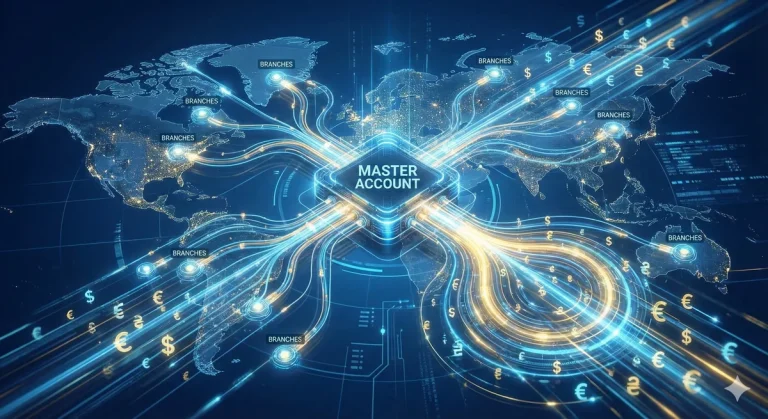
Using Cash Management tools enables the CFO to most effectively solve the task
of operational cash flow management, optimize treasury performance,
and achieve significant savings in time and financial resources.
Introduction
At one point, the company’s management tasked me with maximizing the optimization of financial flows between branches. I proposed applying a scheme using Cash Management tools, which has now been implemented and successfully operating for three years.
Challenges in centralized financial flow management are faced not only by companies with extensive regional branch networks but also by large and medium-sized holding companies. The use of cash flow management tools is complicated because enterprises within a holding often have current accounts in different banks, where service conditions, deadlines, and reporting formats vary significantly.
For this reason, the corporate treasury cannot obtain all necessary information in real-time to assess the liquidity of each subsidiary — and consequently, the group as a whole. This significantly reduces the efficiency of the holding’s working capital usage.
When group funds are consolidated, the bank considers not individual enterprises but the group as a whole when deciding on lending, which substantially improves credit terms.
However, even if accounts are transferred to a single bank, rarely does a holding use the full suite of numerous cash management tools. This means the group incurs additional costs to support credit limits for regional units and is deprived of the ability to actively manage working capital. Furthermore, the head office’s control over branch account service conditions, fee levels, and branch expenses is diminished.
Using the Cash Management family of services allows not only optimizing treasury functions but also increasing the group’s self-funding reserve. Consequently, the group’s debt servicing costs decrease significantly.
A Range of Options
All cash flow management tools can be divided into four groups. Since these tools have not yet become widespread in Ukrainian companies (at the time of writing), I will briefly outline their capabilities for familiarization.
Group 1: Services Related to Cash Flow Control
- Post-Execution Control and Accounting. This service involves collecting and transmitting information to the head office regarding transactions on all accounts of enterprises within the holding. If necessary, such a service is supplemented by capabilities to aggregate payment information across required analytical dimensions (by currency, enterprise, region, etc.). This includes payment identification services (automated recognition of debtors and payment allocation).
- Preliminary Control (Authorization) of Expenditure Transactions. This allows the head office to approve subsidiary expenses before they occur. This service enables the holding to introduce a “third signature” rule for the head office representative on payment documents, while leaving regional enterprises with the ability (and obligation) to conduct business activities and generate payment orders independently.
- Direct Money Management from HQ. This service is relevant for holdings with rigidly centralized financial flow management functions.
Group 2: Services Aimed at Efficient Liquidity Management
These services are designed to ensure the operational, low-cost, and high-yield utilization of both own and borrowed funds.
The key service in this group is Cash Pooling. There are two main types of cash pooling:
- Physical Cash Pooling (Zero Balancing or ZBA). This involves the real transfer of funds to a single account. The account to which funds are swept from other pool accounts (with positive balances) and from which deficits on pool accounts are covered is called the Master Account.
- Notional Pooling. In this case, no physical movement of funds between pool accounts occurs. However, when calculating interest on loans/deposits and/or executing payments, the balances on accounts within the pool are considered jointly (offset against each other).
Various implementation parameters are possible for both types of cash pooling.
Group 3: Services Designed to Reduce Client Operational Costs
For example, for clients with a large number of payers and/or payees, these include payment collection services from individuals in favor of service companies (mobile operators, satellite TV providers, etc.). This example, in addition to centralized reporting, involves organizing special bank procedures that require specifying unique details (Reference Numbers) for each funds recipient in payment documents accepted from individuals.
Another service is bulk payments to individuals based on payment registers — executing a large number of payments (e.g., payroll) based on registers and consolidated payment orders.
This group also includes remote account management and integration with client accounting systems (ERP integration).
The Cash Management family also includes the Standing Order product—”regular payments,” which allow a company to make payments with fixed periodicity (monthly, weekly, etc.) for a fixed amount to the same beneficiary.
Table 1. Summary of Cash Management Tools
| Tool Group | Tools / Services | Key Features / Additional Capabilities |
| Services Related to Cash Flow Control | Post-Execution Control and Accounting | • Collection and transmission of transaction data to the Head Office for all accounts of the holding’s enterprises. • Payment identification (automated debtor recognition and payment allocation). • Can be supplemented with analytical aggregation capabilities (by currency, enterprise, region, etc.). |
| Preliminary Control (Authorization) of Expenditure | • Allows the holding to introduce a “third signature” rule for the Head Office representative on payment documents. • Regional enterprises retain the ability (and obligation) to conduct business activities and generate payment orders independently. | |
| Direct Money Management from HQ | • Relevant for holdings with rigidly centralized financial flow management functions. | |
| Services for Efficient Liquidity Management (Cash Pooling) | Physical Cash Pooling (Zero Balancing) (Consolidation of group funds on one account) | • The account to which funds are swept from other pool accounts (with positive balances) and from which deficits are covered is called the Master Account. |
| Using Group Funds for Payments | • Master Account is not used (e.g., intraday limit sharing). | |
| Notional Pooling (Interest Optimization without Fund Transfer) | • No actual movement of funds occurs between pool accounts. • However, balances on accounts within the pool are considered jointly (offset) when calculating interest on loans/deposits. | |
| Services Designed to Reduce Operational Costs | Settlements with a Large Number of Counterparties | • Collection services: Collecting payments from individuals for service companies (mobile operators, satellite TV, etc.). • Bulk payments: Payments to individuals based on payment registers (e.g., payroll). |
| Remote Management & Integration | • Various versions of “Client-Bank” systems and Internet Banking. • Integration with client’s ERP systems. | |
| Standing Order (Regular Payments) | • Executing payments with fixed periodicity (monthly, weekly, etc.) for a fixed amount to the same beneficiary. |
The Advantages of Fund Consolidation
I would like to dwell in more detail on the tools of the second group (Cash Pooling), which allow for real savings on borrowing costs.
Let’s assume a scenario:
One company branch has a large surplus cash balance at its disposal. Meanwhile, another branch urgently needs funds to make payments—for example, to pay for a delivery of raw materials, components, or to pay employee salaries—but it lacks sufficient liquidity.
The procedure for manually transferring funds from one branch’s account to another takes time. Additionally, this decision must be coordinated with the Head Office financial center, which also causes delays.
The Result: The second branch risks incurring penalties for late fulfillment of obligations.
A solution might be raising “short money” via an overdraft, but this is one of the most expensive credit resources, which will inevitably increase interest expenses.
At the same time, regional financiers at the first branch (with the surplus) might place their excess funds on a short-term deposit. However, the interest rate earned on such a deposit will be significantly lower than the overdraft rate paid by the second branch.
Strength in Unity and Liquidity
Olena Kramar, Head of Cash Management Department, OTP Bank:
When automatically consolidating funds across a group of client accounts, a Master Account is defined, to which balances from other accounts are transferred. These are liquidity management products:
Zero Balancing (ZBA): Automatic zeroing of sub-accounts at a specific point in time with the consolidation of funds on the Master Account.
Target Balancing: Allows regulating the amount of funds and/or the residual balance on accounts after the transfer.
Sweeping: Consolidation of funds on the Master Account on a daily basis after the close of the operating day.
Notional Pooling: Virtual consolidation of funds from several current accounts combined into a group.
The procedure for manually transferring funds from one branch’s account to another takes time. Additionally, this decision must be coordinated with the Head Office financial center, which also causes delays. As a result, the second branch risks incurring penalties for late fulfillment of obligations. A solution might be raising “short money” via an overdraft, but this is one of the most expensive credit resources, which will inevitably increase interest expenses. At the same time, regional financiers at the first branch may place surplus funds from the current account on a short-term deposit, but the interest rate for such placement will be significantly lower than the overdraft rate.
These schemes are possible both with the establishment of an overdraft on accounts (either a single account or a group of accounts) and within the limits of positive cash balances.
For ease of management, there are various system settings that allow using different transfer options and schedules agreed upon with the client to fine-tune the system to specific needs. The following fund transfer options are possible:
- Transfer with a set minimum balance (Peg Balance) on the account;
- Transfer of a fixed amount;
- Use of a “cumulative” balance (transfer occurs only if a certain amount of funds has accumulated on the sub-account);
- Possibility to use a multi-tier sub-account system.
Funds can be transferred to multiple accounts; thus, funds can be both consolidated and distributed among group accounts.
Regulatory Context
Until recently, the adoption of Cash Management products was severely limited by Ukrainian tax and accounting legislation, as well as currency regulations. Today, the situation has improved, but significant restrictions on the application of Cash Management products remain.
In particular, intra-group settlements are not fully regulated, and there are certain difficulties in implementing international products. The limitations of currency legislation on the application of Cash Management products are primarily related to:
The need for the bank to perform the functions of a currency control agent.
The impossibility of freely transferring funds from current accounts of Ukrainian resident clients in foreign currency without providing the necessary documents authorizing such a transfer according to the account regime and NBU regulations.
The adaptation of certain services and products to client needs and, simultaneously, to the requirements of current legislation leads to the fact that a significant part of Cash Management services are customized solutions aimed at meeting the needs of a specific market segment.
In our company, we prefer the tools of the second group, utilizing an internal Cash Management system—meaning without direct bank intervention.
This approach allows us to maximize the speed of transferring resources between branches by saving time from the moment a decision is made to its execution—a benefit that is hard to overestimate. Another indisputable plus: our deposits and loans are opened for the two companies with the highest credit rating with banks (on whose accounts resource consolidation takes place). Thanks to this, we secure the most favorable rates for both deposits and loans.
However, the scheme where Cash Management services are provided by a bank also has its advantages. In this case, there are several options for automated fund consolidation (Cash Pooling).
Option 1: Zero Balancing (ZBA)
This option involves using a unified balance. The accounts of enterprises within the group are combined into a single system (pool). Daily, cash balances from these accounts (fully or subject to a set limit) are transferred to the account of one group participant. This account is called the Master Account.
During the day, the bank executes participant payments and covers negative balances on their accounts by transferring funds from the Master Account. The surplus on the Master Account is placed on deposit. If the group lacks funds, a credit line (overdraft) is opened on the Master Account.
Option 2: Peer-to-Peer Transfer (No Master Account)
This option does not involve using a Master Account. If one pool participant lacks funds to make a payment, the system automatically transfers funds from another participant (who has cash available).
In this case, the selection of the “donor participant” is determined based on established priority rules, account balance limits, and other settings. The Master Account is not used. In both the first and second options, payment automation causes no difficulties; it is merely a matter of configuring the payment rules (algorithm).
Option 3: Virtual Consolidation (Notional Pooling)
In this case, no actual transfer of funds occurs between pool accounts. However, when calculating interest on loans/deposits, the balances on accounts within the pool are considered jointly (interest offsetting). By consolidating group funds, the bank, when deciding on lending, considers not individual enterprises but the group as a whole, which significantly improves credit terms.
Corporate Cash Management: Translating Banking Technologies to Multi-Branch Companies
Oleksandr Zharko, CFO of MKS Company:
Our company has effectively implemented a cash management model similar to Cash Pooling, but without bank participation. The network includes both separate legal entities and Financial Responsibility Centers (FRCs) without legal entity status. I had experience applying an “inter-branch liquidity management” system in a bank and transferred this scheme to the company.
Within a single legal entity with a vast branch network, the issue of optimizing working capital management can be solved in many ways: from having an in-house treasury (as implemented in our company) to outsourcing this function to a bank or, perhaps in the near future, to artificial intelligence—a computer following a preset program.
Banks, by their nature, are multi-branch structures with balance-sheet and off-balance-sheet branches, and managing correspondent accounts is a long-mastered stage for them. Each bank chooses a management model, registers it with the National Bank of Ukraine (NBU), and operates according to it. For example, the head bank holds a main (Master Account) at the NBU and sets usage limits for its branches from it. This technology has been working in banks for over ten years since the formation of independent Ukraine and the implementation of the payment system.
The Cash Pooling tool is essentially the translation of this technology from the closed banking market to the client market—multi-branch companies. However, for a group of companies uniting different legal entities, this technology is not applicable without adjustments.
According to current Ukrainian legislation, legal entities, including those with common owners, cannot simply shuffle account balances between firms: payment purposes (payment details) and contracts are required, and tax consequences arise. In my opinion, within a single quarter, “automatic” fund transfers between firms can be conducted using the payment purpose “provision of temporary financial assistance” (interest-free loan).
In my experience, these tasks are assigned to the group treasury. Obviously, the bank does not possess the full scope of information regarding planned cash flows and the management accounting purpose of payments already made. Therefore, in my view, fully outsourcing group treasury functions to a bank is inadvisable. For example, a bank can be delegated to execute regular payments in a strictly defined amount with a set periodicity, such as office rent. On the other hand, the Treasurer must also keep these operations under control, as situations are not uncommon where, under conditions of limited free funds, there are higher-priority payments.
Overall, the experience of banking professionals in building management systems and structuring cash flows within holding companies or real sector groups is extremely in demand today.
Despite the reduction in interest income, it is profitable for banks to provide Cash Pooling services for the following reasons:
- Attracting Corporate Clients. It is more beneficial for large corporate clients to consolidate all their accounts in a single bank that provides a full suite of Cash Management services.
- Achieving Competitive Advantage. When such settlement and information services are designed and developed by the bank not for a specific client but for an entire segment of the client base following market research, it allows for reduced development costs for new services. Generating profit from launching them to the market undoubtedly reflects positively on the business image of the bank that has chosen this path.
Navigating Legislative Constraints
Using Cash Pooling with the actual transfer of funds to group company accounts is entirely possible.
The most logical and elegant solution involves using intercompany loan agreements. An interest-free loan is subject to taxation risks, so it is more convenient to use interest-bearing loans. Of course, if one enterprise borrows money from another, interest expenses will occur. However, in this case, the interest paid by one group participant to another remains within the group itself. For the group as a whole, such interest payments are not expenses (they are eliminated upon consolidation).
Today, an interest-free loan is considered a legitimate instrument. This opinion is based on the provisions of Item 4, Article 5 of the Law “On Financial Services and State Regulation of Financial Services Markets” No. 2664 dated July 12, 2001:
“The possibility and procedure for providing certain financial services by legal entities that are not financial institutions by their legal status are determined by laws and regulatory acts of state bodies regulating the activities of financial institutions and financial services markets, issued within their competence.”
In 2004, the State Commission for Regulation of Financial Services Markets (Derzhfinposluhy) approved the regulation “On the provision of certain financial services by legal entities – business entities that are not financial institutions by their legal status” (Order No. 21 dated Jan 22, 2004).
Previously, until June 24, 2005, this order applied to legal entities that systematically provided financial services such as financial leasing, providing sureties, and loans of financial assets, or had concluded at least one contract for providing the listed financial services for an amount exceeding 80,000 UAH. In such a case, registration of the legal entity with the State Commission was required, confirmed by a relevant certificate.
However, a year later, on June 24, 2005, amendments were made to Order No. 21 (Order No. 4241). According to the new version of the regulation, its effect now extends only to legal entities—business entities (which are not financial institutions by legal status) that provide financial leasing services.
On March 31, 2006, the State Commission for Regulation of Financial Services Markets of Ukraine issued Order No. 5555 “On the possibility of providing financial services of granting funds on loan and providing sureties by legal entities – business entities that are not financial institutions by their legal status.”
It established that:
“Legal entities that are not financial institutions by their legal status provide financial services of granting funds on loan (except for financial credit) and sureties in accordance with the requirements of civil legislation and taking into account the requirements of Ukrainian legislation on preventing and counteracting the legalization (laundering) of proceeds obtained by criminal means.”
The new Civil Code of Ukraine (CC) specifically provides for the possibility and procedure for granting interest-bearing loans by any entities that do not have the status of a financial institution. This conclusion is most evident when contrasting a Loan Agreement (Dohovir pozyky) and a Credit Agreement (Kredytnyi dohovir).
- Part 1 of Art. 1054 of the CC clearly states that the lender in a credit agreement is a bank or another financial institution.
- Part 1 of Art. 1046 of the CC, however, implies that the lender in a loan agreement can be any subject of civil law (an individual or a legal entity).
Unlike the old Civil Code, a loan agreement is now generally interest-bearing by default. Part 1 of Art. 1048 of the CC states:
“The lender has the right to receive interest from the borrower on the loan amount unless otherwise established by the contract or law. The amount and procedure for receiving interest are established by the contract. If the contract does not establish the amount of interest, its amount is determined at the level of the discount rate of the National Bank of Ukraine.”
A Fallback Option: Promissory Notes
If legislation changes again and the use of direct loans becomes impossible, we can return to the old method using promissory notes (bills of exchange).
In this scenario, one participant incurs a debt to a second participant for securities purchased, while simultaneously holding promissory notes of the second participant, which they present for payment. However, this method is significantly less convenient.
Published:
In &.Financier magazine No. 6, 2007.