Posted by Dmytro Dodenko
As a CFO, I live in a world of strict rules and logic. But what if I told you there is a transaction where my private company is legally bought (we are acquired by a public company), yet when I open our financial statements, it turns out that… we actually bought them?
This is neither a mistake nor fraud. It is one of the most elegant paradoxes in IFRS, known as a “reverse acquisition.”
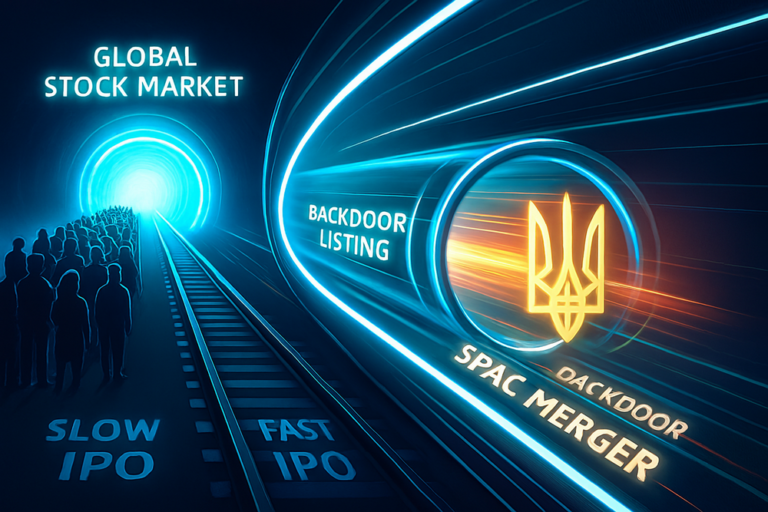
At first glance, this seems like an academic puzzle. But today, for ambitious Ukrainian businesses, this seemingly strange mechanism is one of the most effective and fastest ways to enter global capital markets such as NASDAQ, NYSE, or the LSE (London Stock Exchange). While a foreign holding company is still required to navigate NBU currency restrictions (Exchange Controls), merging with a SPAC allows for a much faster market entry with a pre-agreed valuation, eliminating the risks and uncertainty of the traditional, lengthy IPO process.
A Practical Strategy: “Backdoor Listing”
Let’s imagine our private Ukrainian company (let’s call it “UKR-Tech”) is successful, profitable, and ready to raise international capital.
- The Traditional Path (IPO): We would spend 12-18 months on a roadshow, prospectus preparation, and deep valuation (which would factor in war risks), all while hoping for a favorable market “window.”
- The Alternative Path (Reverse Acquisition / Reverse Takeover): We find a public company already listed on Nasdaq. Most often, this is a “shell company” or a SPAC (Special Purpose Acquisition Company / Blank Check Company) – essentially a “bag of money,” a company with no operations created specifically to find and merge with a private company like ours.
The Legal Form of the Deal: The public shell company (the legal acquirer) issues new shares and uses them to “buy” 100% of our private UKR-Tech (the legal acquiree).
The Economic Substance of the Deal: Our UKR-Tech is significantly larger than the “shell”. Therefore, after the share exchange, the former owners of UKR-Tech receive, say, 90% of the shares of the combined public entity. They gain full control: they appoint the new Board of Directors and manage the business.
We have just witnessed this history in the making: Kyivstar successfully entered Nasdaq specifically through a merger with the SPAC Cohen Circle Acquisition Corp.1
Reporting Algorithm: The CFO’s Paradox
This is where the accounting magic begins. My job as a CFO is to reflect the economic reality, not the legal wrapper.
Step 1: Who Actually Bought Whom? (IFRS 3)
IFRS 3 “Business Combinations” requires identifying the accounting acquirer – the entity that obtained control. In our case, despite the public shell issuing the shares, the owners of UKR-Tech obtained control.
Therefore, for reporting purposes:
- Accounting Acquirer: Our private UKR-Tech.
- Accounting Acquiree: The public shell company (SPAC).
Step 2: Did We “Buy” a Business or a Listing? (IFRS 3 vs. IFRS 2)
My next question is: what exactly does this “shell” we acquired represent?
Scenario A: The “Shell” Is a Real Business (e.g., a smaller operating company)
In this case, IFRS 3 “Business Combinations” applies.
- Consolidation: Our consolidated financial statements will be a continuation of UKR-Tech’s financial statements. UKR-Tech’s assets and liabilities remain at their historical (book) value.
- Purchase Price: We calculate the “deemed consideration” – the fair value of shares we would have had to issue to give the former owners of the public company their stake (e.g., 10%).
- Result: We recognize the public company’s assets and liabilities at their fair value on the transaction date. The difference between the “deemed consideration” and the net fair value of the assets becomes Goodwill.
Scenario B: The “Shell” Is a SPAC (Only Cash and Listing)
This is the most common case (like Kyivstar). And here is the key point: a SPAC holding only cash does not meet the definition of a “business” under IFRS 3.
- Standard: IFRS 3 does not apply. Instead, we apply IFRS 2 “Share-based Payment.”
- Logic: The transaction is treated as if UKR-Tech issued its own shares (payment) to “buy” two things: 1) the SPAC’s net assets (i.e., cash) and 2) the “service of obtaining a stock exchange listing.”
- Result: The difference between the fair value of shares we “deemed to have issued” (i.e., the value of our company) and the fair value of net assets (cash) we received from the SPAC is not Goodwill. This difference is recognized immediately in the Profit and Loss Statement (P&L) as “Listing Expense.”
For a CFO, this means that on the very first day of our public life, I must report a significant non-cash loss. My task is to clearly explain to new investors that this is not an operational failure, but a one-time, expected fee for entering the stock exchange.
Step 3: The Paradox in Separate Financial Statements (IAS 27)
Finally, one more paradox. All this complex logic of reverse acquisition applies only to the consolidated financial statements.
In the separate (unconsolidated) financial statements of the public shell company itself (which is legally the parent), everything is simple: it issued shares and acquired an asset – “Investment in a Subsidiary (UKR-Tech).” This investment is accounted for at cost – that is, at the fair value of the shares issued.
Advantages and Risks for a Ukrainian Company
This strategy is not just a “loophole.” It is a calculated decision with clear pros and cons.
Advantages:
- Speed and Cost: The process is significantly faster and cheaper than a traditional IPO.
- Access to Capital: We don’t just get a listing; we also (in the case of a SPAC) receive the cash that the SPAC raised previously.
- Valuation Certainty: We negotiate the valuation directly with the SPAC sponsors, rather than depending on market volatility during an IPO.
- Retaining Control: Unlike an IPO, which often involves significant dilution of ownership, here the private company owners typically retain majority control.
Risks and Mitigation:
- Risk: Legacy Liabilities (The “Dirty” Legacy). The greatest danger is inheriting hidden debts, obligations, or lawsuits from the public “shell.”
- Mitigation: Comprehensive Due Diligence. Never skimp on legal and financial verification of the “shell.” This is the most critical step.
- Risk: Reputation. Some investors view reverse mergers skeptically due to the lower level of regulatory scrutiny compared to an IPO.
- Mitigation: Choosing a “clean” SPAC with reputable sponsors and committing to full transparency post-deal.
- Risk: Operational Shock. Your management team has likely never run a public company. The requirements for reporting, compliance, and Investor Relations (IR) represent a completely different level of pressure.
- Mitigation: Engage experienced advisors, financial, and legal experts for the deal, and prepare your own financials to an “audit-ready” level in advance.
How to Navigate NBU Currency Restrictions?
This is the most interesting part for Ukrainian business. How do you “buy” an American public company if the National Bank of Ukraine (NBU) prohibits capital outflows for purchasing corporate rights abroad?
The Answer: The deal takes place without money moving from Ukraine. It is a three-move chess game, and the Kyivstar example illustrates it perfectly:
- Move 1: Restructuring (Creating a Foreign HoldCo). The owners of the Ukrainian business (e.g., JSC “UKR-Tech”) create a new holding company in a neutral, investment-friendly jurisdiction (e.g., Bermuda, like Kyivstar Group Ltd., or the Netherlands, Cyprus, etc.). They then transfer 100% of the Ukrainian company’s shares to this new holding. This can be done via a share swap or a debt-to-equity swap (which the NBU recently permitted).
- Move 2: The Merger (Share Swap Abroad). Now, our private company is “OurCo Ltd.” (registered in Bermuda). It is this foreign entity that conducts the reverse merger with the American SPAC. This is a share exchange between two non-Ukrainian legal entities.
- The Result. Money (capital) never left Ukraine for the purchase. Ukraine’s currency legislation applies to cross-border transfers from Ukraine. This transaction and its settlements occur entirely outside the Ukrainian financial system.
Tax Implications? Absolutely.
The Ukrainian owners now own a Controlled Foreign Company (CFC). They are required to report it and, potentially, pay tax on undistributed profits. However, there is an advantage here too: the CFC law exempts profits from taxation if the company is public and its shares are listed on a recognized stock exchange. Thus, the very fact of listing on Nasdaq can help meet the conditions for the CFC tax exemption.
Conclusion
What begins as an accounting paradox – where the buyer becomes the acquired – turns out in practice to be a powerful, proven strategy. For Ukrainian business, this is not just a way to bypass an expensive IPO. It is a structured path to global capital that is absolutely realistic even under martial law and strict currency controls.
1. Kyivstar Group begins trading on Nasdaq under the ticker symbol “KYIV” on August 15, completing its historic public offering – Kyivstar , https://kyivstar.ua/news/id150820250910 ↩