Posted by Dmytro Dodenko
Introduction: The Violinist Analogy and the Fallacy of Investing in Visible Metrics
There is an apt analogy that illustrates a fundamental error in business strategy. Imagine a person striving to become a great violinist. They attend a concert where they see a virtuoso in an evening suit, holding an expensive violin, skillfully wielding the bow. Deciding that this is the path to success, our beginner buys the same suit, the most expensive violin, and starts moving the bow across it. Naturally, the result will be dismal.
From a CFO’s perspective, this person has made a terrible capital investment. They invested in visible, easily accessible assets—the tuxedo and the instrument—while ignoring the true, valuable asset: thousands of hours of practice, innate talent, and a deep understanding of music—that is, the “intangible” assets.
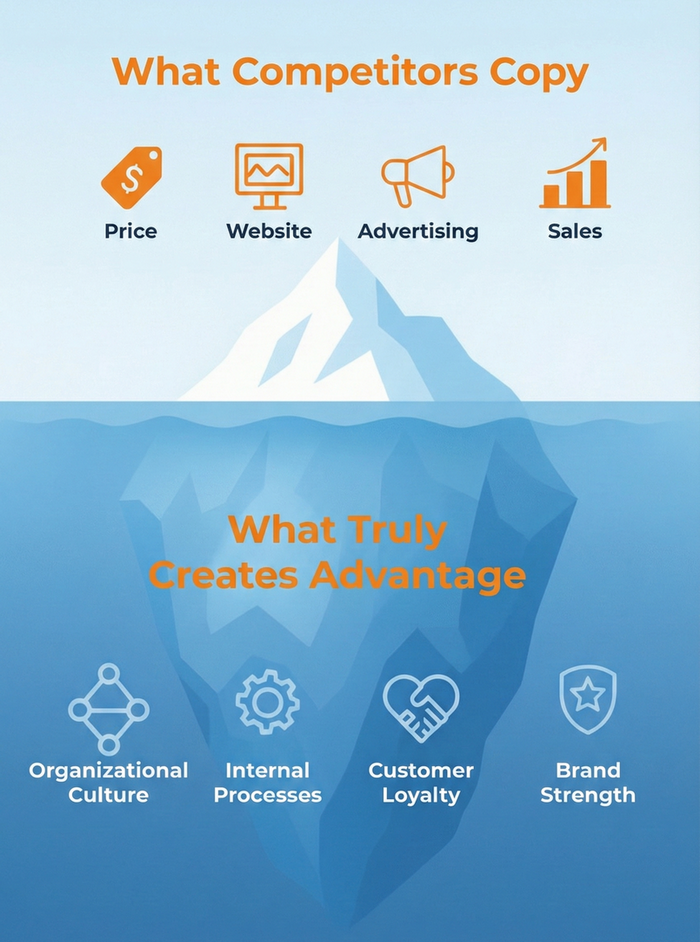
This metaphor perfectly reflects the behavior of companies that copy a competitor’s website (the tuxedo) or their pricing model (the violin) without understanding the hidden operational excellence or corporate culture (the talent) underpinning their success.
The key challenge for any financial executive is capital allocation to generate the highest sustainable return. Chasing competitors by copying their visible actions is a reactive strategy with a low Return on Investment (ROI). It leads to an endless cycle of catch-up, margin erosion, and a lack of market differentiation. This is not just a strategic failure; it is a financial failure.
This report argues that Sustainable Competitive Advantage (SCA), and therefore long-term shareholder value, does not stem from market tactics that can be easily observed and copied. Instead, it is a direct result of the firm’s unique, complex, and often invisible internal resources and capabilities. We will analyze why these advantages are impossible to imitate, prove their value using examples from Ukrainian and global companies, and explore a radical alternative to the conventional wisdom of corporate longevity.
Section 1. Deconstructing Non-Imitable Competitive Advantage
Defining Sustainable Competitive Advantage (SCA)
From a financial perspective, Sustainable Competitive Advantage (SCA) is not merely better performance over a single quarter; it is the long-term ability to generate superior profitability. This is achieved by implementing unique value-creating strategies that competitors cannot copy or substitute. The goal is to outperform specific competitors in a way that is enduring. SCA is a characteristic that creates long-term benefits, allowing the company to maintain its position even amidst market changes and demand fluctuations.
The Resource-Based View (RBV) as a Strategic Lens
To analyze the sources of such an advantage, it is appropriate to use the Resource-Based View (RBV). This theory asserts that a firm’s unique bundle of internal resources (both tangible and intangible) is its primary source of advantage.
From a CFO’s position, the strategy involves identifying, developing, and protecting these high-value internal assets—whether it be proprietary technology, brand reputation, or an exceptional team culture. Resources in themselves are unproductive; their value arises when they are combined and coordinated to perform a specific task.
VRIO Analysis: A Litmus Test for Strategic Investments
VRIO Analysis (Value, Rarity, Imitability, Organization) is a rigorous tool for any CFO to evaluate potential strategic investments. This framework helps determine whether a company’s resources and capabilities can become a source of Sustainable Competitive Advantage.
Let’s examine each component:
- Value: Does the resource allow the company to exploit opportunities or neutralize threats? If not, it is a weakness. A valuable resource increases efficiency or effectiveness.
- Rarity: How many competing firms already possess this resource? If it is ubiquitous, it provides only Competitive Parity, not an advantage.
- Imitability: Do firms without this resource face a cost disadvantage (Barrier to entry) in obtaining or developing it? This is the key to sustainability. There are three main barriers to imitation:
- Unique Historical Conditions (Path Dependency): Gaining access to a resource at a specific time and place that cannot be repeated (e.g., Rozetka’s early market entry).
- Causal Ambiguity: Competitors cannot precisely identify exactly what drives the success.
- Social Complexity: The advantage is based on interpersonal relationships, trust, and culture (e.g., Monobank’s relationship with clients).
- Organization: Does the firm have the structure and readiness to leverage this resource? A valuable, rare, and inimitable resource is useless without the appropriate systems, policies, and culture to utilize it.
Any investment project that does not create a resource that is at least rare and difficult to imitate is, from a financial perspective, an investment in “Competitive Parity.” This is a maintenance cost, not a growth investment.
This approach transforms strategic discussions into financial ones, forcing management to answer the question: “Which box in the VRIO analysis does this investment check? Are we paying for a sustainable advantage, or are we merely renting temporary parity?”
The Non-Imitable Core: Tacit Knowledge and Corporate Culture
Some assets are so difficult to copy that they become a true source of advantage. This is linked to the concept of Tacit Knowledge—unwritten, experience-based “know-how” that cannot be easily codified or transferred.
It is personal experience, intuition, and skills passed down through mentorship and collaboration, not through manuals. Corporate Culture is a form of collective tacit knowledge. You can copy an operating manual, but you cannot copy the shared understanding and trust that allow a team to execute a process flawlessly under pressure.
Table 1: VRIO Analysis in Practice
| Resource / Capability | Valuable? | Rare? | Costly to Imitate? | Competitive Implication |
| Imitable “Advantages” | ||||
| Launching a “Black Friday” Sale | Yes | No | No | Competitive Parity |
| Copying a Competitor’s Website UI | Yes | No | No | Competitive Parity |
| Cutting Price to Match Competitors | Yes | No | No | Temporary Parity (at best) |
| Sustainable Advantages | ||||
| Nova Poshta: Logistics Network | Yes | Yes | Yes | Sustainable Competitive Advantage |
| Monobank: Brand Culture & Loyalty | Yes | Yes | Yes | Sustainable Competitive Advantage |
| Grammarly: AI / Data Flywheel | Yes | Yes | Yes | Sustainable Competitive Advantage |
Section 2. Uniqueness Case Studies: Ukrainian Champions
An analysis of leading Ukrainian companies shows how creating non-imitable assets leads to market dominance. Their success demonstrates four distinct “types” of Economic Moats:
- Socio-Cultural (Monobank),
- Physical-Logistical (Nova Poshta),
- Network Effect/Reputational (Rozetka), and
- Information-Technological (Grammarly).
This proves that sustainable advantage is tied not to a specific industry, but to the nature of the asset being created.
Monobank – Brand Power and Unique Customer Experience (CX)
- Visible Asset (The Tuxedo): An elegant, user-friendly mobile banking app. This is the part competitors try to copy.
- Non-Imitable Core (The Talent): Monobank’s true advantage is built on social complexity and brand identity.
- Founder Communication: The founders are the face of the brand, communicating directly and transparently with users, creating a level of trust and personality that a corporate PR department cannot replicate.
- Gamification and Emotional Connection: Features like the cat mascot, achievement awards, and the “Jar” (Banka) for savings/donations create an emotional, engaging experience that transforms banking from a utilitarian service into something enjoyable. This builds loyalty that goes far beyond interest rates alone. Monobank’s user loyalty has reached 87%, the highest among banks.
- Viral Word-of-Mouth: The unique UX and referral programs turned customers into evangelists (Brand Advocates), drastically reducing Customer Acquisition Cost (CAC)—a key metric for a CFO—and creating a powerful organic growth engine.
- VRIO Analysis: Monobank’s app technology is Valuable, but not Rare or Inimitable. However, its brand culture and customer relationships are Valuable, Rare, and extremely Costly to Imitate due to social complexity and unique historical conditions (founder personalities and market timing).
Nova Poshta – The Fortress of Physical Logistics
- Visible Asset: Red-and-white branding and delivery trucks.
- Non-Imitable Core: A massive, deeply integrated physical network that creates an almost insurmountable barrier to entry.
- Network Scale: With over 11,400 branches and 15,500 parcel lockers in Ukraine alone, the network density and coverage are unrivaled [23]. Replicating such infrastructure would require billions in Capex and years of real estate and logistics work.
- Operational Excellence and Technology: Years of investment in automated sorting terminals, Warehouse Management Systems (WMS), and route optimization create economies of scale and efficiency that a new player cannot achieve from day one [24].
- Default Brand Trust: “Nova Poshta” has become synonymous with delivery in Ukraine [25]. This brand awareness is a powerful asset built over two decades.
- VRIO Analysis: The logistics network is Valuable, Rare, and incredibly Costly to Imitate due to massive capital expenditures and the unique historical conditions of its creation. This is a classic example of a moat built on physical infrastructure.
Rozetka – An Ecosystem of Trust and Data
- Visible Asset: A massive e-commerce website.
- Non-Imitable Core:First-mover advantage, which allowed Rozetka to build a self-reinforcing ecosystem of trust and data.
- Accumulated Social Proof: Years of collecting millions of customer reviews and ratings create a trusted resource that competitors cannot instantly generate. This data is a unique, valuable asset.
- Marketplace Network Effect: As the largest platform, Rozetka attracts the most sellers, which in turn attracts the most buyers, creating a virtuous cycle. This two-sided network effect is extremely difficult for new players to overcome.
- Logistics Expertise and Infrastructure: Early and significant investments in proprietary warehouses and fulfillment operations give Rozetka control over the customer experience and create efficiency.
- VRIO Analysis: Rozetka’s website technology is imitable. However, its brand trust, vast repository of user-generated content (UGC), and the two-sided network effect of its marketplace are Valuable, Rare, and Costly to Imitate due to unique historical conditions and causal ambiguity.
Grammarly – A Self-Reinforcing AI-Based Moat
- Visible Asset: A browser extension that checks grammar.
- Non-Imitable Core: A Data Network Effect that makes its AI progressively smarter and harder to compete with.
- The Data Flywheel: Grammarly’s AI/Machine Learning models train on vast amounts of user interaction data. Every correction a user accepts or rejects makes the system smarter for all other users. A new competitor starts with a “dumber” algorithm and cannot catch up without a similar scale of data.
- Freemium Model as a Data Collection Engine: The free version acts as a massive funnel, providing the data needed to refine the premium product, creating a sustainable competitive advantage.
- Technological Depth: The company’s investments in optimizing complex AI models to run efficiently on user devices demonstrate a level of engineering expertise that serves as a significant barrier to entry.
- VRIO Analysis: Core AI algorithms, fueled by a massive and proprietary dataset from millions of users, are Valuable, Rare, and extremely Costly to Imitate. The cost is not just financial; it is the cost of time and data, which is almost impossible to bypass.
Section 3. The Graveyard of Imitators: Global Cautionary Tales
Global markets are rife with examples of giant companies that failed while trying to copy the success of competitors. These failures highlight a critical financial error: imitators systematically underestimate switching costs for customers who are already integrated into a mature ecosystem. They focus on the cost of building a competitive product but ignore the far higher cost of persuading millions of customers to abandon their existing habits, data, and networks.
Microsoft Zune vs. Apple iPod – Copying the Product, Not the Ecosystem
- The Imitation: Microsoft launched Zune as a direct competitor to the iPod, successfully copying and, in some aspects, even improving the physical MP3 player. Zune had a larger screen, an FM tuner, and Wi-Fi file-sharing capabilities.
- The Non-Imitable Ecosystem: Apple’s dominance stemmed not from the iPod itself, but from its tightly integrated ecosystem: iTunes software for music management, the iTunes Store for legal music purchasing, and a vast market of third-party accessories. This created high switching costs for users who had already invested time and money in building their iTunes libraries. Microsoft created a competitive device but failed to replicate decades of user habits and their lock-in to libraries.
- Financial Consequences: This was not a cheap experiment. Zune was part of Microsoft’s Entertainment and Devices division, which, although profitable thanks to Xbox, operated with significantly lower margins than the company’s core software businesses. The failure of Zune meant significant opportunity costs and direct financial losses. While exact financial results for Zune were not disclosed, write-offs for other failed hardware products in the same division, such as $900 million for Surface RT and $7.6 billion for Nokia, illustrate the scale of such errors. The Zune failure became a multi-billion dollar lesson on the difference between a product and an ecosystem.
Google+ vs. Facebook – Replicating Features, Not the Network
- The Imitation: Google leveraged its immense engineering talent and financial resources to create Google+, a social network that replicated and, in some cases, improved upon Facebook’s features (e.g., “Circles” for better privacy control).
- The Non-Imitable Network Effect: Facebook’s value lay not in its features, but in its users. It possessed the “Social Graph”—a map of real-world connections. A user’s friends, family, and colleagues were already on Facebook. Google+ was a technically perfect platform, but it was an “empty party.” Users had no compelling reason to rebuild their entire social network from scratch on a new platform.
- Financial Consequences: Although Google never disclosed the exact cost, estimates suggest investments reached hundreds of millions, if not billions of dollars. The real price was the opportunity cost—years of focus and engineering talent from one of the world’s most powerful companies were poured into a project that was strategically flawed from the start because it attempted to copy an asset (the Network Effect) that is inherently impossible to copy.
Section 4. The Alternative Path: The “Built to Sell” Philosophy
The previous analysis leads to a clear conclusion: true competitive advantage lies in creating a business that is fundamentally hard to copy. It is this uniqueness that creates its value.
However, a critical paradox arises here for the founder: if the company’s “magic” is so deeply tied to its unique culture, processes, and even the leader’s vision, how can this value ever be realized through a sale? A business that cannot function without its creator is not a tradable asset; it is a high-paying job.
The solution lies in a counterintuitive approach: building a company to be “disposable”—not in the sense of short-lived, but in the sense of being independent of the founder. This means shifting from creating a business that runs you, to creating a business that can thrive without you.
This is the “Built to Sell” philosophy described by John Warrillow. The goal is not longevity for longevity’s sake, but the creation of a valuable, transferable asset.
Core Principles of a Business Ready for Sale:
- Specialization and Standardization: Focus on one scalable service offering where you can be the best. Avoid individual, bespoke work that depends on your personal expertise. This makes the service teachable and the revenue predictable.
- Systematization and Documentation: Create robust, documented processes for everything—from sales to service delivery. This makes the business less dependent on any single individual and makes it easier for a new owner to understand and manage.
- Positive Cash Flow and Diversified Client Base: Demonstrate predictable, recurring revenue from a broad range of clients, where no single client accounts for more than 15% of revenue (Client Concentration Risk). This lowers the risk for a potential buyer.
- Building a Management Team: The ultimate goal is to make the founder replaceable. A business that relies on the owner for day-to-day operations is not a sellable asset; it is just a job.
Justifying the “Built to Sell” Philosophy from a CFO’s Perspective:
- Ultimate Risk Management: A business dependent on its founder is a high-risk asset. Building it for sale forces the creation of systems that mitigate this “Key Person Risk.”
- Focus on Tangible Value: This philosophy compels a relentless focus on what an external buyer values: predictable profits, scalable systems, and a strong management team. It rejects vanity projects and directs capital toward creating a clean, efficient value-generation machine.
- The Antithesis of Imitation: The “Built to Sell” strategy is deeply inwardly focused. Instead of reacting to competitors, you proactively refine your own unique, documented, and transferable formula for success.
The Paradox of Detachment
The “Built to Sell” model is not about being “disposable” in a negative sense, but about achieving strategic “detachment.” It reimagines the founder’s role from an indispensable hero to the architect of a self-sustaining system.
It is this detachment that creates the market value of the business. A buyer purchases a business for its future cash flows. If these flows depend on whether the founder stays, the business valuation is significantly discounted. If the cash flows are generated by the system, the valuation is much higher.
Thus, the act of making the business “disposable” from the founder’s perspective is the very act that maximizes its financial value as an asset. The paradox is that by preparing to let go of it, you make it infinitely more valuable.
Conclusion: Your Uniqueness Is Your Only Non-Depreciating Asset
The violinist analogy is not just a clever anecdote; it is a stark financial warning. Investing in the visible attributes of success (the tuxedo) is a recipe for margin compression and strategic irrelevance. True, protected value lies in invisible, inimitable assets that pass the VRIO test.
As a financial executive, my recommendation is unequivocal: shift your investment focus inward.
Conduct a rigorous VRIO analysis of your own company’s resources. Determine what is truly unique and defensible—whether it is your culture, your processes, your data, or your network. Stop funding imitative, “me-too” projects, and direct capital toward deepening this unique “economic moat.”
In a world of rapid change, the only asset that does not depreciate is the unique soul of your organization. You cannot copy it from a competitor, and if you build it right, they will never be able to copy it from you. This is the only reliable path to sustainable profitability and strategic independence.