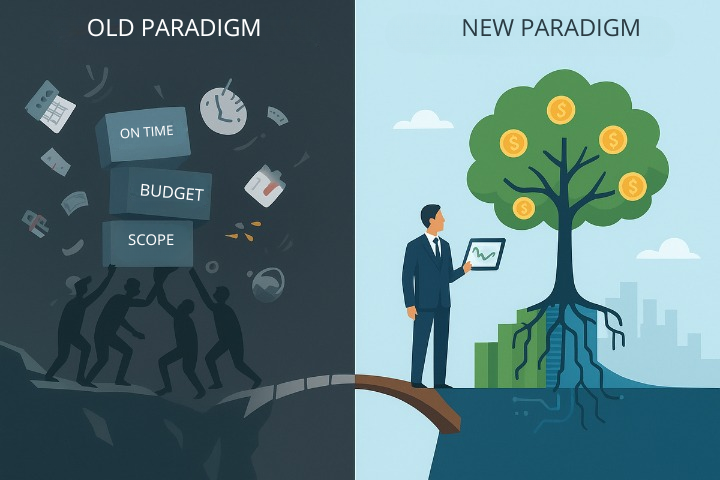
“A project that meets its targets but delivers no benefits is a failure.”
Introduction. The Flawed Metric of Success and the Price of “Effective” Failure
What constitutes successful project completion? The Project Manager proudly presents the final report: a new software system is implemented, a production line is installed, a marketing campaign is launched. The slides demonstrate brilliant figures: the project was completed two weeks ahead of schedule, and the budget was not just met—5% was saved. Applause, congratulations, bonuses are issued. This is a picture of triumph, the classic definition of success in project management. Isn’t it?
But a year later, when I analyze the company’s financial statements—Profit and Loss (P&L), Cash Flow, and Balance Sheet—I see no trace of the expected impact. Operating costs haven’t decreased, market share hasn’t grown, and customer retention remains at the same level.
We celebrated the successful completion of a project that actually turned out to be a strategic failure. This isn’t just a nuisance; it is a waste of the company’s most valuable resources—capital, time, and human potential. We have experienced what I call an “effective failure.”
In this article, I argue that the traditional “Iron Triangle” of project management—Time, Cost, and Scope—is not a measure of success, but merely a tactical indicator of execution efficiency. It is a necessary, but far from sufficient condition. The true, and in my view, the only criterion for success is realized and sustainable business benefits. As the foundational thesis that inspired this conversation aptly notes: “A project that meets its targets but delivers no benefits is a failure.” This is not a semantic game, but a fundamental shift in mindset that separates companies that survive from those that thrive.
My role as Chief Financial Officer (CFO) has long evolved beyond traditional accounting and cost control. Today, I am a strategic partner to the CEO, responsible for the architecture of the company’s financial health and long-term growth. This means that every investment proposal, every project vying for the company’s capital, passes through my filter. And this filter is tuned not to the question “Can we do this?”, but to the significantly more important one—“Should we do this?”
This article is my perspective on how companies can learn to ask this question correctly and, more importantly, find substantiated answers to it, ensuring sustainable value long after the project team is disbanded.
Section 1: The Strategic Shift – From Outputs to Benefits
To move beyond the outdated paradigm of “on time and on budget,” business needs a structured methodology that connects the daily work of project teams with the strategic ambitions of the Board. This methodology exists, and it is called Benefits Realization Management (BRM)1.
This is not just another buzzword from business school, but a disciplined approach serving as a bridge between project execution and the achievement of strategic goals. BRM forces us to abandon superficial judgments and clearly distinguish key concepts that are often confused.
The Conceptual Framework: Outputs, Outcomes, and Benefits
At the core of BRM lies a simple yet critical distinction between three levels of project achievements. Understanding this hierarchy is the first step toward changing corporate culture.
- Outputs: This is a specific, tangible or intangible product created by the project team. It is something that can be “delivered” or “handed over.” Examples include a new CRM system, a constructed logistics center, a launched mobile app, a completed rebranding, or trained personnel.
- The Question: “What did we make?”
- Insight: Completing the project at this stage is only the beginning of the journey, not the end.
- Outcomes: This is a change in operational activity or behavior enabled by the use of the project’s output. It is what the business starts doing differently. For example, the sales department starts actively using the new CRM to track client interactions; the logistics department starts processing parcels through the new automated center; clients start placing orders via the new mobile app.
- The Question: “What changed in the way we work?”
- Insight: This is a critical stage because, without a change in behavior, the Output remains just an expensive toy.
- Benefits: This is a measurable improvement resulting from the changes (Outcomes) that is perceived by stakeholders as value. A benefit must always be quantifiable and tied to the organization’s strategic goals. This could be a 15% sales growth, a 10% reduction in Opex, an increase in Net Promoter Score (NPS) by 10 points, or a 25% reduction in Time-to-Market for a new product.
- The Question: “What value did we get?”
- Insight: It is Benefits, not Outputs or Outcomes, that justify the investment in a project.
The Benefits Realization Lifecycle
Success is not born on the day of the ceremonial ribbon-cutting. It requires purposeful effort and constant monitoring throughout the entire Benefits Lifecycle, which often lasts for years after the project is officially closed. BRM offers a clear roadmap consisting of four key stages.
1. Benefits Identification and Definition
This stage happens before the first dollar of funding is allocated. Together with all key stakeholders, we must clearly answer the question: “Why are we doing this?” We define exactly what benefits we expect, how they link to the company’s strategic goals (e.g., market share growth or profitability increase), and how we will measure them.
- Key Tool: At this stage, a Benefits Map is created, which visually links project Outputs to Outcomes and final Benefits.
2. Benefits Realization Planning
After identification, we develop a detailed document—the Benefits Realization Plan. This document is no less important than the project plan itself. In it, we fix specific metrics and KPIs for each benefit, define targets, set timeframes for achievement, and, most importantly, appoint a “Benefit Owner.”
- Role Definition: A Benefit Owner is usually a senior manager who bears personal responsibility for ensuring the expected value is actually realized.
The Benefits Realization Plan in Practice
To understand how this works, let’s look at a simplified example. Imagine a manufacturing company, “Alpha-Prom,” is considering a project to implement a new ERP system. Instead of simply approving a budget for “ERP implementation,” we create a Benefits Realization Plan. This is not a technical document, but a business commitment.
Table 1: Example of a Benefits Realization Plan for an “ERP Implementation” Project
| Benefit | Strategic Goal | Metric / KPI | Baseline / Target (Before/After) | Timeframe | Benefit Owner |
| Reduced inventory carrying costs | Profitability Increase | Inventory holding cost as % of turnover | 5% / 3.5% | 12 months post-launch | COO (Chief Operating Officer) |
| Shortened financial close cycle | Reporting efficiency & quality | Days to close the month | 10 / 5 working days | 6 months post-launch | CFO (Chief Financial Officer) |
| Improved demand forecasting accuracy | Production & Logistics optimization | Forecast Error (MAPE) | 25% / 15% | 9 months post-launch | Supply Chain Director |
| Improved order fulfillment timeliness | Customer Satisfaction Increase | On-Time Delivery (OTD) | 85% / 95% | 12 months post-launch | CCO (Chief Commercial Officer) |
This document fundamentally changes the dynamic. Now we have not just a project, but a set of concrete, measurable business goals with clearly defined responsible individuals.
The COO is responsible not for the ERP system being installed, but for the inventory carrying costs actually decreasing to 3.5%. This transforms an abstract idea into a concrete, manageable, and accountable value creation plan.
- Implementation and Monitoring: At this stage, the project team performs its work, but does so with a constant focus on creating conditions for future benefits. In parallel, the “Benefit Owner” and the Finance Department start tracking interim KPIs. We do not wait for project completion to start measuring. We constantly ask: “Are we moving in the right direction to create value?” This allows for timely course correction if we see deviations from the plan.
- Sustainment and Optimization: The project is completed, the team is disbanded, but for the Benefit Owner, the most important work is just beginning. At this stage, it is necessary to ensure that new processes are fully integrated into the company’s operations. Benefits must not just be gained once, but sustained in the long term. Moreover, we must seek ways for their further growth and optimization, because market conditions change, and what was an advantage yesterday may become an industry standard tomorrow.
The fundamental change BRM brings is that responsibility for project success extends beyond the Project Manager and is distributed among business leaders who become “owners” of the final value. This transforms the project from an isolated technical exercise into an integral part of strategic business management.
The Evolution of the CFO Role
This shift from focusing on outputs to managing benefits is not accidental. It is a direct consequence of the evolution of the Chief Financial Officer’s role.
Traditionally, the CFO was viewed as a Chief Controller, whose task was to minimize costs and ensure the accuracy of financial reporting. In such a paradigm, any project was, in essence, a cost center that needed to be executed as cheaply and quickly as possible.
However, in the modern business environment characterized by high volatility, technological breakthroughs, and global competition, the CFO role has changed drastically. We are now required not just to count money, but to be strategic thinkers, risk management experts, and full-fledged partners to the CEO in shaping the company’s future.
When a CFO starts thinking like a strategist, their view on projects inevitably changes. They cease to be just a line item in the expense budget and turn into investments competing for the company’s limited capital. And any investment must be evaluated not by how efficiently funds were “utilized” (spent), but by the return it generated for shareholders.
Thus, the requirement to evaluate projects by their contribution to company value—that is, by realized benefits—is a logical continuation of the evolution of financial leadership. This is not just a change in project management methodology; it is a fundamental shift in corporate governance philosophy, initiated and supported by the modern CFO.
Section 2. The Language of Numbers: How We Measure Real Value Before, During, and After the Project
Shifting Success Criteria
As a CFO, I am deeply convinced that all strategic conversations, ambitions, and visionary ideas must ultimately be translated into the universal language of business—the language of numbers. Emotions, enthusiasm, and loud statements at presentations do not create shareholder value. Correctly chosen and carefully calculated financial metrics do.
That is why the transition from the “execution” paradigm to the “value” paradigm requires a change in the toolkit we use to evaluate projects.
The table below vividly demonstrates this evolution. It visualizes the fundamental difference between the old and new approaches, serving as a checklist for any executive wishing to understand the maturity of their company’s investment management system. This is not just a comparison; it is a call to action that forces us to ask: “By what criteria do we actually evaluate success, and are we not deceiving ourselves by celebrating tactical victories that mask strategic defeats?”
Table 2: The Evolution of Project Success Metrics
| Criterion | Old Paradigm (Focus on OUTPUTS) | New Paradigm (Focus on BENEFITS) |
| Primary Dimension | Execution Efficiency | Value Creation |
| Key Metrics | • Budget adherence • Deadline adherence (On-time) • Scope delivery | • Achievement of target Net Present Value (NPV) • High Return on Investment (ROI) • Achievement of strategic KPIs (Market Share growth, NPS, etc.) |
| Time Horizon | From project start to finish | Entire Benefit Lifecycle (often years after project completion) |
| Accountability | Project Manager | “Benefit Owner” (usually a C-level executive) & Project Sponsor |
| Typical Question | “Did we build what we planned?” | “Did we get the value we expected?” |
Pre-Project Assessment: The Financial “Filter”
Before a company commits to investing millions in a new project, we must pass it through a rigorous financial filter. This is not bureaucracy, but a necessary step for rational capital allocation.
- Net Present Value (NPV):
NPV answers the fundamental question: “Will this project create more value for our shareholders than we invest in it, considering that money today is worth more than money tomorrow?”
The logic of NPV is that we forecast all future cash flows the project will generate (additional revenue, cost savings) and bring them (discount them) to today’s value using a discount rate that reflects risks and the cost of capital. Then we subtract the initial investment from this sum.
The decision rule is uncompromising:
- If NPV > 0, the project creates value, and we can consider it.
- If NPV < 0, the project destroys value, and we must reject it, regardless of how “innovative,” “strategically important,” or “image-boosting” it is. A project with a negative NPV is a financial black hole.
- Return on Investment (ROI):
This is the simplest and most understandable metric for non-financial managers. It is calculated as the ratio of net profit from the investment to its cost and is expressed as a percentage.
Although ROI has a significant flaw—it ignores the Time Value of Money (TVM) and the time horizon of returns—its ease of communication makes it a useful tool for initial screening of ideas and presentations for a broader audience. However, for the final investment decision, I always insist on the NPV calculation.
Post-Implementation Monitoring: Closing the Accountability Loop
The project is completed, the team is celebrating, but for me as the CFO and for the “Benefit Owner,” the work is just beginning. To make the system work, we must close the accountability loop. This means that 6, 12, or 24 months after the launch, we conduct a Post-Implementation Review (PIR)2.
During the PIR, we return to the original business case and compare the forecasted figures with the actual ones.
- If we predicted that a new production line would reduce operating costs by 15%, we must see this in the P&L statement of the relevant unit.
- If we expected a new marketing platform to increase the conversion rate by 2%, we must see this in the sales department reports.
This process is critical for two reasons. First, it confirms (or refutes) the fact of benefit realization and allows for corrective actions. Second, it creates a priceless knowledge base for the company, enabling us to make more accurate forecasts in the future and learn from our own mistakes.
Bridging the Gap Between Strategy and Execution
Company strategic goals are often abstract: “become a market leader,” “improve customer experience,” “increase operational efficiency.” Projects, in turn, offer very specific solutions (outputs): “launch a new mobile app,” “implement an ERP system,” “build a new warehouse.”
There is a conceptual gap between these two levels. How exactly will this specific app lead to abstract market leadership?
This is where financial metrics like NPV and ROI, along with related operational KPIs (NPS, Customer Lifetime Value, Churn Rate), act as a bridge or a “translator.” They force project initiators to decompose the abstract goal.
They must quantitatively justify how their Output (the app) will lead to specific Outcomes (more downloads, higher ratings, more frequent sessions), which, in turn, will create measurable Business Benefits (revenue growth from mobile users, reduced support costs via chatbots). These benefits, expressed in cash flows, form the basis of the NPV calculation.
Thus, a business case built on these metrics is not just a bureaucratic formality. It is the most important strategic document that translates an idea into the language of financial value, making it measurable, manageable, and, most importantly, accountable.
Section 3. Lessons from Practice: Ukrainian Cases of Benefit Realization
Theory and methodology provide a solid foundation, but true understanding comes only when we see how these principles work (or fail) in real business. The Ukrainian market, despite all challenges, demonstrates vivid examples of companies that, intuitively or consciously, apply benefit-oriented thinking, allowing them not just to survive, but to dominate.
Case 1: “Nova Poshta” – Investing in Speed and Market Dominance
The leader of the Ukrainian express delivery market, “Nova Poshta,” is a textbook example of how investments in operational infrastructure turn into an undeniable strategic advantage.
- Project: A large-scale, multi-year program for the construction and automation of innovative sorting terminals across the country3. This is not a single project, but a portfolio of interconnected investments aimed at radically rebuilding the company’s logistical “backbone.”
- Output: A network of new, high-tech sorting centers equipped with advanced conveyor systems and robots for automatic sorting of parcels of various weights—from small packages to heavy cargo4. This is the physical embodiment of the investment program.
- Outcome: Radical acceleration and almost complete automation of sorting processes, allowing for the processing of hundreds of thousands of shipments per day with minimal human intervention3. This is the company’s new operational reality.
- Realized Benefits: This is where the true goal of the investment is revealed, extending far beyond simple construction.
- Operational Efficiency: The numbers speak for themselves. The implementation of robots doubled the sorting productivity for small parcels (up to 2 kg). At cargo terminals using robotic carts (AGVs), productivity increased by 30%4. This is a direct, measurable financial benefit expressed in a reduction of the cost per parcel processed.
- Customer Experience (CX) & Loyalty: For the client, the main value is speed and reliability. By reducing the time a parcel stays at the terminal from hours to minutes, Nova Poshta creates a key competitive advantage that is hard to copy. This directly impacts customer satisfaction and loyalty, which are long-term assets.
- Strategic Dominance: The most important benefit is strategic. By investing billions in unique infrastructure, the company creates an extremely high barrier to entry for any potential competitor. This is not just a construction project—it is a conscious strategy aimed at cementing the position of the undisputed market leader for decades to come. From a CFO’s perspective, this is an investment not in walls and equipment, but in long-term market capitalization.
Case 2: “Rozetka” – Digital Back-Office Transformation for Scalability
The giant of Ukrainian e-commerce, “Rozetka,” faced a challenge typical of fast-growing businesses: how to manage interactions with thousands of suppliers without drowning in paperwork and operational chaos. Their solution is a vivid example of how a back-office automation project can become the foundation for future scaling.
- Project: Comprehensive implementation of electronic document management systems (EDI for commercial documents and EDO for legally significant ones) to automate supplier interactions via the “Vchasno” platform5.
- Output: A single integrated digital platform allowing for the exchange of the full spectrum of documents—from orders and price lists to contracts and reconciliation statements—in electronic format.
- Outcome: Almost complete automation of ordering processes, delivery confirmations, invoicing, contract signing, and exchange of primary documentation. 98% of suppliers were migrated to EDI5.
- Realized Benefits: This project was not an end in itself; it was aimed at solving specific business problems and creating measurable value.
- Radical Reduction of the Operational Cycle: The time required to process one order (from receipt to final system entry) decreased from over 50 minutes to just 3 minutes. This is not just optimization; it is a revolutionary efficiency boost that freed up immense human resources for higher value-added tasks.
- Direct Cost Savings: The company eliminated significant costs associated with paper workflow: paper, printing, postal and courier services, as well as the physical archiving of millions of documents (monthly traffic in the EDI system alone is about 250,000 documents)5.
- Operational Risk Reduction: Automation significantly reduced the number of human errors that inevitably occur during manual data processing. Furthermore, having all documents in a single digital archive greatly simplified and accelerated tax audits, minimizing the risks of fines and sanctions5 .
- Foundation for Scalability: Perhaps the most critical benefit is strategic. By creating an efficient and automated interaction system, Rozetka gained the ability to easily onboard hundreds of new suppliers and expand its assortment without proportionally increasing the back-office staff. This project became an investment in the business’s capacity for further exponential growth.
Section 4. Global Perspective: Strategic Investments and Costly Mistakes
To truly understand the power of benefit-oriented thinking, it is useful to look beyond the local market and examine international experience. Global companies provide us with both exemplary models of value realization and highly instructive cautionary tales about how technologically perfect projects can suffer crushing defeat by ignoring the true needs of the business and stakeholders.
Case 3: “Schneider Electric” (France) – A Benchmark for Benefit Realization and Measurement
A global leader in energy management and automation, Schneider Electric is a model of how a company can systematically approach digital transformation by clearly defining, realizing, and measuring benefits at every step.
- Project: The Global “Smart Factory Program,” involving the digital transformation of over 100 proprietary manufacturing sites worldwide6.
- Output: Widespread implementation of Industry 4.0 technologies, including Industrial Internet of Things (IIoT) sensors, cloud platforms for data collection and analysis (specifically AVEVA Insight), augmented reality tools for operators, and predictive maintenance systems.
- Outcome: A transition from reactive to proactive production management. Managers and engineers gained access to real-time equipment performance data, allowing them to make decisions based on analytics rather than intuition and to predict potential failures before they occur.
- Realized Benefits: Schneider Electric does not just declare benefits; it rigorously measures and publishes them, making this case particularly valuable. The numbers are impressive:
- Increased Reliability: At one of the showcase plants in Batam (Indonesia), equipment downtime was reduced by 44% within one year7.
- Improved Customer Service: Thanks to process optimization, the on-time delivery rate increased by 40%7.
- Energy Efficiency and Sustainability: The program achieved significant resource savings. Energy consumption at “Smart Factories” decreased by 21–26%7.
- Reduced Operating Costs: Maintenance and repair costs decreased in the range of 30–50% due to the shift to a predictive model8.
- Rapid Return on Investment (ROI): For specific initiatives, such as the implementation of the AVEVA Insight cloud analytics platform at the Lexington plant (USA), the payback period was less than 6 months9.
This is a perfect example where the company did not just execute a project but created a comprehensive system for constant measurement, analysis, and reporting of realized business benefits, turning its factories into living laboratories of efficiency.
Case 4: “LEGO” (Denmark) – Revival Through Focus on Strategic Benefits
The story of the Danish toymaker LEGO in the early 2000s is a classic business drama about a company that nearly died by losing touch with its essence, and its triumphant return through a strategy based on creating intangible yet incredibly powerful benefits.
- Context: By late 2003 and early 2004, LEGO was on the brink of bankruptcy. The company was recording massive losses, had accumulated $800 million in debt, and sales had dropped by 30% year-on-year10. The reason was a catastrophic loss of focus: trying to catch up with the digital age, LEGO scattered its resources on clothing production, theme parks, failed video games, and other non-core businesses, forgetting its flagship product—the brick.
- The Turnaround Strategy (CEO Jørgen Vig Knudstorp): The new CEO applied not just a cost-cutting tactic, but a deep strategy of returning to the brand’s core, combining it with an innovative approach to value creation11. One of the brightest projects of this era was the creation of a feature-length animated film.
- Project (Example): Creation of “The LEGO Movie” (2014).
- Output: A critically and commercially successful animated film. With a budget of $60 million, worldwide box office receipts totaled about $468 million10.
- Direct Financial Benefit: Significant profit from the box office, which in itself is a successful investment project.
- Strategic (Far More Important) Benefits: The true value of this project lay not in box office receipts, but in the long-term impact on the business:
- Brand Revitalization and Repositioning: The film, with incredible humor and warmth, reminded the world of the joy of creativity, building, and play. It made the LEGO brand relevant and “cool” again for a new generation of kids growing up in the era of smartphones and tablets.
- Creation of a Powerful Ecosystem: The film’s success launched an entire ecosystem of products: new themed toy lines, successful video games, merchandising. Each element of this ecosystem reinforced the others, creating a synergistic effect.
- Explosive Stimulation of Core Product Sales: The film became a gigantic, incredibly effective advertising campaign for classic LEGO sets. It inspired millions of children and adults to return to building, leading to explosive sales growth of the company’s core, highest-margin product.
- Overall Financial Result: The results of this strategy were phenomenal. The company’s profits quadrupled between 2008 and 2010, outpacing even Apple in growth rates at the time12. This case brilliantly proves that the greatest value often lies in strategic, intangible benefits that are hard to calculate at the start but have a transformational impact on the entire business.
Case 5: “Maersk” (Denmark) and TradeLens – A Cautionary Tale of a Project Without Benefits
While LEGO is a success story, the TradeLens project, initiated by another Danish giant Maersk together with IBM, is a textbook example of an “effective failure” and a powerful warning for any business.
- Project: TradeLens – an extremely ambitious blockchain platform aimed at full digitization and creating a single, transparent, and trusted source of data for the entire global shipping industry13.
- Output: From a technological standpoint, the project was successful. The Maersk and IBM teams created a sophisticated, functional, secure platform that worked exactly as intended. They completed the task on time and, likely, within budget.
- Why Did It Fail? The project collapsed because it failed to realize its key, fundamental benefit – creating a unified, trusted ecosystem for the entire industry. The reasons for this failure lie exclusively in the realm of benefits management:
- Lack of Obvious Benefits for Key Stakeholders: The platform failed to offer sufficient and understandable value for other major carriers, freight forwarders, ports, and customs authorities to make them want to join. They saw no clear business benefits to justify their integration costs, risks, and the need to share their data14.
- Fundamental Conflict of Interest: Many market players who are direct competitors of Maersk quite logically feared that a platform controlled by their main rival could be used against them. The lack of neutral management and a transparent governance model destroyed the trust that is the foundation of any ecosystem14.
- Lesson: A project that is technically perfectly executed but does not create obvious, measurable, and fair value for key stakeholders and does not solve their real problems is doomed to failure. TradeLens is a vivid example of how billions of dollars were invested in creating an “Output” that brought real “Benefits” to no one but its creators.
Analysis: The Asymmetry of Perception
The TradeLens failure is not just a setback but a profound lesson on the nature of modern business ecosystems. The project was built on the logical, but as it turned out, naive assumption that all supply chain participants equally strive for transparency and efficiency.
However, it failed to account for a fundamental asymmetry of perception: what is a “benefit” for one participant (Maersk gaining access to unique data and potentially new revenue sources) is a “risk” or “threat” for another (competitors forced to share commercial information with the market leader).
The project failed to answer the key question every rational business player asks before joining a new platform: “What’s in it for me?” (WIIFM).
The benefits for the ecosystem as a whole were abstract (“greater transparency,” “efficiency”), while benefits for individual participants were unclear, disproportionate, or even negative. This differs radically from successful platforms like Apple’s App Store or Amazon’s Marketplace, where an obvious and mutually beneficial model is created for all parties: developers gain access to billions of customers, and customers to millions of apps and goods.
Conclusion: For projects whose success depends on the network effect and the engagement of many independent participants, it is not enough to simply identify benefits for one’s own company. It is necessary to design a business model from the very beginning where every key ecosystem participant receives clear, measurable, and fair benefits that exceed their costs and risks. Failure in this strategic design is a mistake that no technology, however advanced, can fix.
Conclusion. Integrating Benefits Management into the Company DNA
Throughout this conversation, we have analyzed a fundamental shift in understanding project success. We have seen that a blind focus on adhering to budgets and deadlines is a shortsighted approach that often leads to “effective failures”: projects that are formally completed but bring no real value to the business. In contrast, true market leaders like Nova Poshta and Rozetka in Ukraine, as well as Schneider Electric and LEGO on the global stage, achieved outstanding results by viewing projects not as cost centers, but as strategic investments in long-term, measurable business benefits. The cautionary tale of TradeLens, in turn, vividly demonstrated that even perfect technological execution cannot save a project that creates no value for its ecosystem.
As a CFO, I am convinced that the transition to a value-oriented culture is not just desirable, but vital for any company striving for sustainable development. This requires not just declarations, but concrete, systemic steps that must be integrated into the very DNA of corporate governance.
Recommendations for Executives
- Demand Robust Business Cases. No significant project should receive funding without a clearly written business case. This document should not just describe what will be done, but detail why. It must identify specific, measurable benefits, clearly link them to the company’s strategic goals, and, most importantly, justify financial feasibility using metrics like NPV and ROI.
- Appoint “Benefit Owners”. For every expected benefit declared in the business case, a specific senior manager from the relevant business unit must bear personal responsibility. Their task is not to manage the project, but to ensure that after its completion, the result is correctly integrated into operational processes and the business actually starts receiving the planned value. The Project Manager’s responsibility ends with the delivery of the result; the “Benefit Owner’s” responsibility continues until the value is fully realized.
- Implement Post-Implementation Reviews (PIR) as Mandatory Practice. Make regular (6–12 months later) analysis of completed project results an integral part of the financial and strategic cycle. Did we achieve the KPIs we counted on? Were our cash flow assumptions confirmed? If not, why? This is not a witch hunt, but an organizational learning process that allows avoiding repeated mistakes and making more accurate forecasts in the future.
- Reward Value, Not Just Execution. Revise the motivation system for project teams and their sponsors. Bonuses should depend not only on whether the team stayed within budget and deadlines, but also on whether key KPIs related to benefits were achieved during the first year after launch. This will create a powerful incentive for all participants to think about final value, not just intermediate results.
The transition from thinking in categories of “costs” to thinking in categories of “investment in value” is perhaps the most important and difficult transformation a modern company can undertake. It is a path from chasing short-term efficiency to building long-term, sustainable prosperity. And it is on this path that the role of the CFO finally transforms: from a simple controller and guardian of the budget to a true strategic partner and architect of the future, helping to build a business that doesn’t just work, but creates real value.
Sources:
- Benefits Realization Management: A Practice Guide, – PMI, accessed Oct 22, 2025. https://www.pmi.org/standards/benefits-realization ↩
- What is benefits management and project success? – APM, accessed Oct 22, 2025. https://www.apm.org.uk/resources/what-is-project-management/what-is-benefits-management-and-project-success/ ↩
- Logistics Operator: Innovative Development Path… Economy and Society, accessed Oct 22, 2025. https://economyandsociety.in.ua/index.php/journal/article/download/1874/1806/ ↩
- Nova Poshta uses robots at its terminals… Retailers.ua, accessed Oct 22, 2025. https://retailers.ua/uk/news/menedjment/12891-novaya-pochta-ispolzuet-robotov-na-svoih-terminalah-eto-pomoglo-uvelichit-proizvoditelnost-sortirovki-melkih-posyilok-v-2-raza ↩
- Use of digital service ecosystem in retail (Rozetka case), Vchasno.ua, accessed Oct 22, 2025. https://vchasno.ua/case/rozetka/ ↩
- Schneider Electric, your partner for your industrial operation digital transformati, accessed Oct 22, 2025. https://www.afnet.fr/Content/2022-ASDAPD/11-PLamboley.pdf ↩
- Schneider Electric’s Smart Factory Program: A lighthouse for digital transformation in manufacturing, – AVEVA, accessed Oct 22, 2025. https://www.aveva.com/content/dam/aveva/documents/perspectives/success-stories/SuccessStory_SEBatamSmartFactoryLongForms.pdf.coredownload.inline.pdf ↩
- Smart Factory and Smart Distribution Center | Schneider Electric USA, accessed Oct 22, 2025. https://www.se.com/us/en/work/campaign/smart-factory/ ↩
- Schneider Electric Launches First Smart Factory in the U.S. Demonstrating Quantifiable, Real-Time Benefits of Innovative EcoStruxure Solutions, accessed Oct 22, 2025. 2025, https://www.se.com/ww/en/about-us/newsroom/news/press-releases/schneider-electric-launches-first-smart-factory-in-the-u-s-demonstrating-quantifiable-real-time-benefits-of-innovative-ecostruxure-solutions-5f627dfb07483225ea4fb77f ↩
- LEGO: One of the Greatest Turnaround Stories In Corporate History – Platform01 Consulting, accessed Oct 22, 2025. https://platform01consulting.com/insights/lego-one-of-the-greatest-turnaround-stories-in-corporate-history ↩
- The future of LEGO Education amidst the greatest turnaround in history MANAGEMENT DECISION, accessed Oct 22, 2025. https://lup.lub.lu.se/student-papers/record/9150944/file/9150948.pdf ↩
- A True Toy Story: LEGO’s Incredible Turnaround Tale – The CFO Centre, accessed Oct 22, 2025. https://www.cfocentre.com/sg/true-toy-story-legos-incredible-turnaround-tale-2/ ↩
- TradeLens by Maersk – IBM Blockchain Supply Chain Solution – PixelPlex, accessed Oct 22, 2025. https://pixelplex.io/blog/maersk-ibm-tradelens-blockchain-supply-management/ ↩
- Why Maersk and IBM’s blockchain platform TradeLens is closing down, accessed Oct 22, 2025. https://piernext.portdebarcelona.cat/en/technology/the-closure-of-tradelens/ ↩