
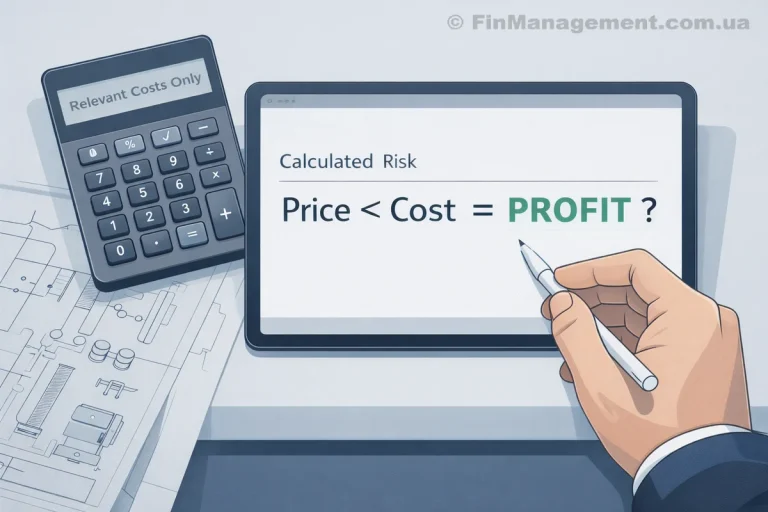
Analyzing a Real-World Manufacturing Case Study
The Situation
A company sells its products (coated rolled steel) in Ukraine and exports to several European countries.
In a month of low demand, when the company has idle production capacity, it received a request from a buyer in a new country. They want to purchase 60 tons of coated steel at a price of 21,000 UAH/t.
The regular selling price for this product is 22,000 UAH/t. The company has no prior orders from this country.
However, according to the Sales Department, even a one-time sale would introduce the new market to the product’s quality and could potentially allow for future entry into this market at regular prices.
The Dilemma: Should the company accept this offer?
Let’s look at the budget information for this month
Table 1: Monthly Budget Data
| Item | Total, UAH | Per 1 ton, UAH |
| Direct Materials | 95,480,000 | 17,050 |
| Variable Manufacturing Overheads | 8,736,000 | 1,560 |
| Fixed Manufacturing Overheads | 9,240,000 | 1,650 |
| Variable Labor (Wages) | 1,624,000 | 290 |
| Fixed Labor (Salaries) | 3,472,000 | 620 |
| Total Production Cost | 118,552,000 | 21,170 |
| Revenue | 123,200,000 | 22,000 |
| Gross Profit | 4,648,000 | 830 |
Analysis
At first glance, it seems the order should be rejected because the offered price of 21,000 UAH/t is lower than the full production cost of 21,170 UAH/t.
However, a closer examination of the costs reveals that certain production expenses will remain unchanged regardless of whether we accept this order or not.
Table 2 presents the change in revenue and costs if the order is accepted. This highlights which information is relevant for this decision.
Table 2: Incremental Analysis
| Item | Reject Order, UAH | Accept Order, UAH | Difference (Relevant Cash Flow), UAH |
| Direct Materials | 95,480,000 | 96,503,000 | 1,023,000 |
| Variable Mfg Overheads | 8,736,000 | 8,829,600 | 93,600 |
| Fixed Mfg Overheads | 9,240,000 | 9,240,000 | 0 |
| Variable Labor | 1,624,000 | 1,641,400 | 17,400 |
| Fixed Labor | 3,472,000 | 3,472,000 | 0 |
| Total Production Cost | 118,552,000 | 119,686,000 | 1,134,000 |
| Revenue | 123,200,000 | 124,460,000 | 1,260,000 |
| Gross Profit | 4,648,000 | 4,774,000 | 126,000 |
As we can see, in this situation, selling a batch of 60 tons at a price below the full production cost will actually generate 126,000 UAH of additional profit for the company.
However, before making a final decision, it is crucial to consider a number of qualitative factors:
- Will selling at a lower price affect future market prices and relationships with existing clients (Cannibalization risk)?
- Will this order prevent the company from accepting more profitable offers during the production period (Opportunity cost)?
- Is this the best use of the company’s free resources?
Strategic Recommendation
1. Accept the order, but with conditions:
- Strict Volume Limit: Define the contract clearly as a “one-time supply” or “trial batch.”
- Prepayment: Require full or partial prepayment to minimize non-payment risks in a new market.
- Parallel Search: Continue looking for alternative, higher-margin orders.
2. Monitor Consequences:
- Track competitor reactions over the next 3 months.
- Evaluate the conversion rate into permanent contracts at regular prices after 6 months.
As a CFO, I always emphasize the importance of conducting such deep analysis. A correct understanding of cost relevance allows you to leverage idle capacity, generate additional margin, and even open new markets, turning seemingly “loss-making” orders into a source of profit.
You can read about how to make decisions in other situations in my articles: Costing Traps (Part 1), (Part 2), (Part 3), as well as Weighted Average Cost Is a Fiction and other articles on this site.
FAQ:
Should we accept an order priced below full cost?
Yes, it can be beneficial if the price covers variable costs (relevant costs) and makes a contribution to covering fixed costs. The key condition is the availability of spare capacity and the absence of more profitable alternatives.
What are relevant costs in management decision-making?
These are future costs that differ as a result of a specific decision. In the case of special orders, typically only variable costs (materials, direct labor) are relevant, whereas fixed overheads remain unchanged and should not influence the decision.
What are the risks of selling at a reduced price?
Key risks include: price cannibalization (regular customers demanding similar discounts), market dumping, filling capacity with low-margin orders (the opportunity cost of displacing more profitable work), and the risk that the low price will become the expected norm (precedent) for the customer.