
Costing Traps (Part 3)

Costing Traps (Part 3)

Why Accounting Cost Is a Poor Criterion for Decision-Making

Posted by Dmytro Dodenko

As we have already established, for decisions regarding the production and sale of additional product volumes and other choices, it is advisable to use variable costing rather than accounting production cost, which includes fixed expenses (see Costing Traps, Part 1).

Furthermore, when choosing between multiple products to produce and sell, the preferred product is typically the one that yields a higher contribution margin upon sale. Contribution margin is the difference between sales revenue and variable costs.

And if different batches of raw materials with different prices are used to produce a single product type, then to maximize profit, it is necessary to separate the variable cost in accounting when using cheap and expensive raw materials and compare the cost of the product made from expensive raw materials with selling prices (see Costing Traps, Part 2).

The Paradox

However, in some cases, choosing a product with a lower contribution margin per unit can actually bring the enterprise more profit than choosing a product with a higher margin per unit.

Case Study: Steel Rolling & Galvanizing

Let’s consider a simplified planning example:

An enterprise produces thin-sheet galvanized steel. There are two main production sections: the Rolling Mill and the Galvanizing Line.

Raw material (1.2mm thick black sheet metal) is processed at the Rolling Mill into thinner sheets of two types: 0.8mm and 0.4mm. Then, a zinc coating is applied to the resulting thin sheet at the Galvanizing Line.

The sequence of operations is identical for both product types; they differ only in processing time and selling prices.

  • Reducing metal from 1.2mm to 0.8mm requires one pass.
  • Reducing it to 0.4mm requires two passes.

Therefore, the rolling time for 0.8mm thickness is half that of 0.4mm thickness.

Galvanizing occurs at a constant speed per square meter of surface area. However, 1 square meter of 0.8mm steel weighs twice as much as 1 square meter of 0.4mm steel. Therefore, calculated per ton, galvanizing 0.8mm metal is twice as fast as 0.4mm metal.

Data for each product type

Table 1: Product Data

Metric0.4mm0.8mm
Weekly Demand, tons5,0005,000
Selling Price per ton, UAH21,70820,083
Variable Cost per ton, UAH19,73818,649
Rolling Time per ton, min105
Galvanizing Time per ton, min84
Total Production Time, min189

The operating time for each production section is 7 days a week, 24 hours a day, totaling 43,200 minutes per month.

The company’s Operating Expenses amount to 9 million UAH per month (including rent, energy costs, and salaries — everything necessary to ensure the company’s operation).

The Question: Which product mix allows maximizing the company’s profit?

Capacity Analysis

The company lacks sufficient capacity to produce the entire product range. Specifically, the Rolling Mill capacity is insufficient (Table 2):

Table 2: Production Time Requirements

SectionTime for 5,000t of 0.4mm, minTime for 5,000t of 0.8mm, minTotal Required Time, min
Rolling50,00025,00075,000
Galvanizing40,00020,00060,000

Available time for each section per month = 43,200 minutes.

The Decision Dilemma

We cannot produce everything the market is willing to buy, so we must decide exactly what to produce and sell. To maximize profit, we need to identify which product is more profitable and produce it to meet market demand. If there is time left on the Rolling Mill, we will produce the second product.

Using traditional methods (cost accounting), let’s determine the cost of each product and identify which one is more profitable. To calculate profit, we need to know variable costs (raw materials, etc.), costs to maintain the machinery, and other indirect costs.

Table 3 shows that 0.4mm steel appears “better” than 0.8mm steel. It has a higher Contribution Margin, while the amount of indirect (fixed) costs remains constant regardless of the choice.

Table 3: Contribution Margin Calculation

Metric0.4mm0.8mm
Selling Price per 1 ton21,708 UAH20,083 UAH
Variable Costs per 1 ton19,738 UAH18,649 UAH
Contribution Margin per 1 ton1,970 UAH1,434 UAH

Scenario A: The Traditional Approach

Following this logic, we will produce 4,320 tons of 0.4mm galvanized steel, which will consume all available time:

4,320 tons × 10 min = 43,200 min on the Rolling Mill.

No time will remain for 0.8mm galvanized steel.

Table 4: Production Plan (Scenario 1)

Metric0.4mm0.8mmTotal
Production Plan, tons4,3200
Price per 1 ton, UAH21,70820,083
Revenue, UAH93,778,560093,778,560
Variable Costs per 1 ton, UAH19,73818,649
Total Variable Costs, UAH85,268,160085,268,160
Total Contribution Margin, UAH8,510,40008,510,400
Operating Expenses, UAH(9,000,000)
Net Profit (Loss), UAH(489,600)

The Result: Failure

Unfortunately, this managerial decision results in a monthly loss of 0.5 million UAH.

Scenario B: The Alternative Approach

But before closing the company, let’s see what happens if we first produce the maximum possible volume of 0.8mm steel, and use the remaining time to produce 0.4mm steel.

  1. Priority Production: Since producing 1 ton of 0.8mm steel requires 5 minutes on the Rolling Mill, for 5,000 tons we will need 25,000 minutes.
  2. Remaining Capacity: We have a total of 43,200 minutes, meaning 18,200 minutes will remain (43,200 – 25,000).
  3. Secondary Production: Since producing 1 ton of 0.4mm steel requires 10 minutes on the Rolling Mill, we can utilize the remaining time to produce 1,820 tons (18,200 / 10).

New Product Mix:

  • 1,820 tons of 0.4mm steel
  • 5,000 tons of 0.8mm steel

The new profit calculation is shown in Table 5:

Table 5: Production Plan (Scenario 2)

Metric0.4mm0.8mmTotal
Production Plan, tons1,8205,000
Price per 1 ton, UAH21,70820,083
Revenue, UAH39,508,560100,415,000139,923,560
Variable Costs per 1 ton, UAH19,73818,649
Total Variable Costs, UAH35,923,16093,245,000129,168,160
Total Contribution Margin, UAH3,585,4007,170,00010,755,400
Operating Expenses, UAH(9,000,000)
Net Profit, UAH1,755,400

The Financial Turnaround

We changed nothing in our company’s operating conditions, yet instead of a 0.5 million UAH loss, we achieved a 1.8 million UAH profit per month!

Classic cost accounting failed to provide us with the correct information about which product contributes most to the company’s profit growth. We increased the production volume of the “least profitable” product while reducing the volume of the “most profitable” one, and our profit increased.

As we can see, allocating all production costs to products (costing) does not provide all the necessary information for planning and decision-making. The Theory of Constraints (TOC) offers a different approach.

The Theory of Constraints: A Systemic View

Eliyahu Goldratt’s Theory of Constraints is a philosophy of system improvement. Goldratt posits that an organization is primarily a system, not just a collection of processes. Whether it thrives or declines depends on how competently the interaction of its elements is structured.

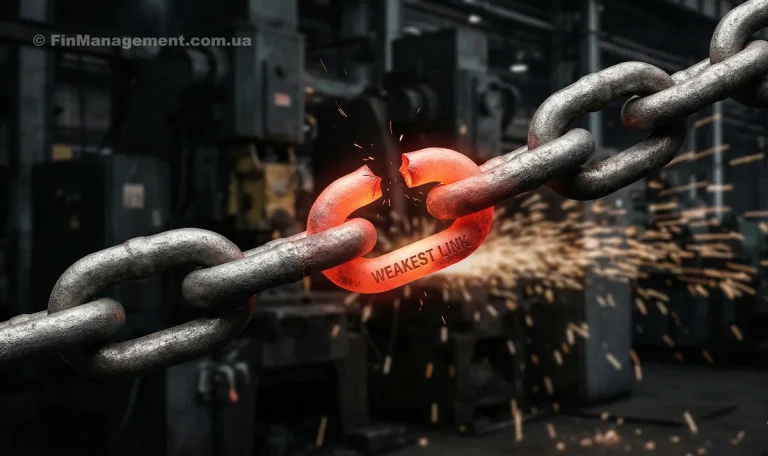
Moreover, he asserts that systems are like a chain (or an intertwining of chains), and the performance of the entire system depends on the performance of the Weakest Link (Bottleneck). Therefore, no matter how much you improve existing processes, only efforts aimed at strengthening the weak link will lead to noticeable improvements.

  • The Weak Link is the system’s Constraint.
  • TOC is the methodology designed to manage such constraints.

As a result, the organization, as a system, gains the ability to manage change and improve rapidly and consciously.

Goldratt compares systems to chains. Consider a chain as a simple system. Its goal is to withstand a certain pulling force. Suppose you constantly increase the tension on the chain. Can you do this indefinitely? Of course not; eventually, the chain will break.

  • Where will it break? At the weakest link.
  • How many such links can there be? One—and only one. The chain will break at a single point, and this weak link is the constraint determining the strength of the entire chain.

It must be acknowledged that any system is created to achieve a goal. For a business enterprise, this goal is “to make more money now as well as in the future.”

Any other declared goals, such as “customer satisfaction,” are unattainable without achieving this primary goal. Owners or shareholders invest their money in this specific enterprise precisely to get more money. If the enterprise does not earn more money, shareholders will invest elsewhere. In a developed capital market (Mature capital market), this is done through buying and selling company shares.

Thus, every action performed by any part of the organization must be evaluated by how it impacts the achievement of the overall goal.

Defining the Constraint

A system constraint can be described as anything that prevents the system from achieving higher performance relative to its goal.

In reality, any system can have only a very small number of constraints. Typically, at any given moment, there is only one constraint. We verified this with the chain example. At the same time, any system must have at least one constraint. This is explained by the fact that if nothing limited the system’s performance, its results would be infinite. If an enterprise had no constraints, its profit would be infinite.

The Production Chain Example

Let’s consider a simple production system where raw materials pass through five processing stages to become finished goods that are sold immediately. The enterprise produces only one type of product. Each stage is a link in the production chain.

  • Market Demand: 15 units per day.
  • System Goal: To make as much money as possible from selling products.

Suppose we want to strengthen the chain (improve the system). Where would be the most logical place to focus our efforts? On the weakest link! Is it worth strengthening something else, something that is not a constraint? Of course not. The chain will still break at its weakest link, no matter how much we strengthen the others. In other words, efforts applied to non-constraints will not produce immediate and noticeable improvements in the system’s performance.

Where is the constraint of this chain?

Answer: At Stage 3, since it cannot produce more than 6 units per day, regardless of how much is produced at other stages. Which stages do not determine the throughput capacity of this production? All the others.

Now, suppose we strengthened the weakest link by double — increasing the capacity of Stage 3 to 12 units per day. What happened to the whole chain? It became stronger (throughput increased), but now another link is the weakest, and the chain’s capabilities are limited by the strength of that link. In our case, this will be Stage 4.

Internal vs. External Constraints

Continuing the improvement process, we can reach a point where the capacity of each stage of our production, and thus the entire enterprise (the whole chain), exceeds market demand.

This means we have eliminated internal constraints in production, and now the constraint is Market Demand. That is, the constraint is located outside our system. However, it is still a constraint. And to lift it, we will have to take other measures: expand the product range, accelerate order fulfillment, etc.

Goldratt’s Five Focusing Steps

Goldratt developed five sequential steps that help focus efforts precisely on what will allow for the fastest improvement of the entire system.

1. Identify the System’s Constraint.

Which element of the system contains the weakest link? What currently sets its maximum performance? Is it an internal factor (a resource or a policy) or an external one (market, supply, supplier, or again, a policy)? If the identified constraint can be eliminated without significant cost, do it immediately and return to step one. If not, proceed to the second step.

2. Exploit the System’s Constraint (Maximize use).

Goldratt means that we must maximize the utilization of the throughput capacity of the link that is currently the system’s constraint. In other words, answer the question: “How can we squeeze the maximum out of the limiting element without significant additional costs and thereby weaken the negative impact of the constraint on the entire system’s performance?”

  • Example: If the system constraint is market demand (sales volume), we need to intensify market efforts and try to increase turnover.
  • Example: If an internal resource acts as the constraint, we should use this resource as efficiently as possible to prevent any downtime (Idleness).

3. Subordinate Everything Else to the Constraint.

Once the constraint is identified (Step 1) and the decision on how to exploit it is made (Step 2), we tune the entire system to subordinate its operation to this decision. Other resources must work at the speed of the constraint—no faster and no slower.

Then we analyze the results of our actions: does this constraint still hold back the entire system? If not, we have eliminated it and proceed to Step 5. If yes, the constraint still exists, and we move to Step 4.

4. Elevate the System’s Constraint.

If Steps 2 and 3 are insufficient to eliminate the constraint, we must evaluate possible ways to “elevate” it (or them, if there are several). “Elevate” means increasing the resource’s capacity. For an internal resource, it is necessary to increase its productive time. Standard methods here include purchasing additional equipment, hiring more staff, adding overtime hours, or introducing additional shifts to bring operating time up to 24 hours a day. As a result, the constraint will be broken, and another element of the system will become the new constraint.

5. Return to Step One (Warning: Do Not Let Inertia Become the Constraint).

If the constraint is broken in Steps 3 or 4, we must return to Step 1 and start the cycle anew. Our task is to identify the next element holding back the system.
The warning about inertia reminds us that we must not become complacent or stop at what has been achieved: the cycle never ends. We must seek out and eliminate constraints, constantly remembering that due to interdependence and variability, every change we introduce into the system will affect the constraints we previously eliminated. We may need to pay attention to them again and make appropriate adjustments.

The Logic of Change

The Five Focusing Steps are directly related to the three change questions (What to change? What to change to? How to cause the change?).

  • To understand what to change, we look for constraints (Step 1).
  • To find out what changes are needed, we decide how best to exploit the constraint and subordinate the system to this decision (Steps 2 and 3).
  • If this does not help, we increase the capacity of the weak link and completely lift the constraint (Step 4). Steps 3 and 4 also specify “how to cause the change.”

Back to the Case Study

Now, let’s return to our galvanized steel production example (Tables 1-5). We are considering the simplest chain where raw material passes through two processing stages to become a finished product. Each stage is a link in the production chain.

Where is the constraint of this chain?

Answer: At Stage 1 “Rolling,” because the entire necessary volume of products cannot be produced there, regardless of the fact that Stage 2 “Galvanizing” can produce more than needed.

We have already looked at how to exploit this system’s constraint (Steps 2 and 3) by prioritizing the product with the highest throughput per minute (Throughput per Bottleneck Minute). Let’s move to Step 4 (Elevate).

To increase the enterprise’s profit, we need to increase the volume of products produced. This requires certain costs. But how do we determine if these costs are justified? To answer this question, we must know how this decision will affect sales.

Scenario-1: If we invest money and increase the capacity of the Galvanizing Unit (reducing processing time there), will we be able to sell more products?

Answer: No, because the maximum sales volume is determined by the Rolling Mill, and we did not change its capacity. As a result, we will increase investments and expenses (due to depreciation), but sales volume will not change. This means the enterprise’s profit will decrease.

Investing in the Constraint: A Case for ROI

Let’s consider another scenario. A proposal has been received to invest 10 million UAH to reduce the production time of 1 ton of 0.4mm steel by 5 minutes on the Rolling Mill (meaning, after modernization, we can roll 0.4mm steel in one pass instead of two).

The Question: How will this affect the company’s profit?

To answer this, we must determine how this decision will impact sales.

Will we be able to sell more products?

Yes. Since the Rolling Mill determines the maximum sales volume, and the rolling time for 1 ton of 0.4mm metal has decreased by 5 minutes, we can increase production and sales volumes.

Previously, we could produce 5,000 tons of 0.8mm steel and only 1,820 tons of 0.4mm steel. This mix consumed 100% of the Rolling Mill’s time.

Now, the production time for 1 ton of both product types on the Rolling Mill is identical — 5 minutes.

Therefore, we can produce the maximum quantity of the product that yields the maximum contribution margin per unit—5,000 tons of 0.4mm steel, which will take 25,000 minutes.

With the remaining time (43,200 – 25,000 = 18,200 min), we will produce 3,640 tons of 0.8mm steel (18,200 / 5).

Let’s calculate our new profit

Table 6: Production Plan (Scenario 3)

Metric0.4mm0.8mmTotal
Production Plan, tons5,0003,640
Price per 1 ton, UAH21,70820,083
Revenue, UAH108,540,00073,102,120181,642,120
Variable Costs per 1 ton, UAH19,73818,649
Total Variable Costs, UAH98,690,00067,882,360166,572,360
Total Contribution Margin, UAH9,850,0005,219,76015,069,760
Operating Expenses, UAH(9,000,000)
Net Profit, UAH6,069,760
Total Contribution Margin, UAH9,850,0005,219,76015,069,760
Operating Expenses, UAH(9,000,000)
Net Profit, UAH6,069,760

The Investment Result

So, we invested 10 million UAH, and our monthly profit increased from 1.8 million UAH to 6.1 million UAH.

Our investment pays off in less than three months. And the useful life of the modernized equipment is much longer. Therefore, this is a highly profitable proposal.

The False Assumption of Traditional Accounting

Classic cost accounting (based on calculating product cost) cannot provide quality information for decision-making because it assumes that all enterprise resources are equally important.

This is akin to trying to increase the strength of a chain by reinforcing the first link you come across. We know that the strength of a chain is determined by the strength of its weakest link. This means we can increase the strength of the entire chain only by strengthening its weak link. But cost accounting does not view the company as a system and therefore sees no difference between company resources.

Defining Global Metrics

Before improving any system, we must define the global goal of the system, as well as metrics that allow us to judge the impact of any subsystem and any local decision on this global goal.

We have already established that the company’s goal is “to make more money now as well as in the future.” But how do we measure the impact of local decisions on the system as a whole?

Goldratt developed a very simple method to determine the effectiveness of a specific managerial decision in terms of achieving the entire system’s goal. Every action is evaluated by its impact on three parameters: Throughput, Inventory (Investment), and Operating Expenses. The author of the theory gives these concepts very precise definitions.

The Three Pillars of TOC Metrics

According to Goldratt, every system should be measured by three global operational measures:

  • Throughput (T): The rate at which the system generates money through sales (not production). It is the difference between sales revenue and Totally Variable Costs (TVC) over a specific period.

Formula: T = Sales – TVC

  • Investment (I) / Inventory: All the money that the system has invested in purchasing things which it intends to sell (raw materials, work in process) or all money currently held within the system (assets, equipment).
  • Operating Expenses (OE): All the money the system spends in order to turn Investment into Throughput. In other words, this is money leaving the system (rent, salaries, energy).

The Universal Decision Checklist

When making any managerial decision, you should ask yourself three questions:

  1. Will this increase Throughput? If so, how?
  2. Will this reduce Investment? If so, how?
  3. Will this reduce Operating Expenses? If so, how?

If the answer to all questions is positive, implement the decision immediately and be confident that it will benefit the system as a whole. If you are in doubt (e.g., T increases but OE also increases), you need to calculate the net impact (Net Profit = T – OE).

Throughput vs. Contribution Margin: The Labor Nuance

The definition of Throughput (T) is similar to Contribution Margin, but there is a critical difference: TOC deducts only totally variable costs (mostly raw materials).

For example, Direct Labor costs in TOC are typically not classified as variable. This is because if we decide not to produce a specific product batch, labor costs usually remain: we do not immediately fire workers; we assign them to other tasks. Even in the case of complete downtime, labor legislation often requires paying workers a significant portion of their average earnings (e.g., 2/3 of the salary). Therefore, Labor is treated as a Fixed Cost and goes into Operating Expenses (OE).

Investment vs. Assets

Investment (I) in TOC is similar to the concept of Assets in classical accounting. However, in TOC, the value of Finished Goods and WIP inventory includes only totally variable costs (materials). Factory overheads and other semi-fixed costs are not capitalized in inventory but are written off immediately as Operating Expenses (OE).

Conclusion: How to Choose the Product Mix?

So, how do we decide on the assortment for production (like in our galvanized steel example)?

The rule is simple: Identify the Constraint and prioritize the product that yields the highest Throughput per unit of Constraint (in our example, per minute of the Rolling Mill).

TOC Management Accounting (Throughput Accounting) is:

  • Effective: It allows identifying products that contribute most to the company’s profit growth and empowers executives to make fast, correct decisions.
  • Simple: It removes the complexity of allocations.
  • Easy to understand: Even for non-financial managers.